John 6

Jesus feeds 5,000+

  1. Escalating widespread popularity
  2. Withdrawal for recuperation and teaching
  3. The test
  4. The miracle
    1. Preparation
    2. Procedure
      1. Gratitude
      2. Abundance
      3. Measured result
      4. Learning result
  5. Withdrawal to the Father
    1. The priority of ministry
    2. The pursuing crowd
  6. The Bread of Life
    1. Essential and available
    2. Obtained through work
      1. The work of trust
      2. Searching for signs
      3. The pointed challenge
      4. The true bread
  7. Given by the Father & raised up by the Son
    1. The fact
    2. The basis of choice
    3. The end goal
      1. 1. None are lost
      2. 2. All are resurrected
      3. 3. Eternal life is received
    4. The crowd response
      1. A physical focus
    5. Jesus’ rebuke
      1. A spiritual focus
      2. A spiritual climax
        1. Only Jesus has seen God
        2. The bread of life is his flesh
        3. His flesh is food and his blood is drink
        4. Remaining in Jesus remaining in the Father
          1. Remaining in Jesus
          2. Jesus remaining in the Father
          3. Rejecting Jesus, the Father and the Spirit
          4. To whom shall we go?
          5. Post-script

Escalating widespread popularity

Sometime after this, Jesus crossed to the far shore of the Sea of Galilee (that is, the Sea of Tiberias),[1] and a great crowd of people followed him because they saw the signs he had performed by healing the sick.

(vv.1-2)

John now introduces another cameo of the interaction of Jesus with people. In this cameo, John covers his interaction with a crowd compared to his previous cameos featuring the interaction of Jesus with individuals.

By now, large crowds were looking for him. John cites the primary reason for these crowds was Jesus performing multiple healing miracles. John would have observed a good spread so far on his journey with Jesus. That is not an everyday occurrence in any one’s life. It would be a spectacle to go and see. Jesus had only recently chosen his first small group of six disciples including two sets of brothers working as young fishermen on the shores of the Sea of Galilee. So far they had only begun to see examples of what he meant by becoming fishers of men, if his aim was for them to do what he was doing. What they were witnessing following him was out of the ordinary. It was supernatural. Did Jesus actually intend that one day they would do supernatural healings in their task of fishing for men?

Matthew provides more insight into the rapid growth of large crowds from a sizeable geographic region following Jesus so early in his public ministry.

23 Jesus went throughout Galilee, teaching in their synagogues, proclaiming the good news of the kingdom, and healing every disease and sickness among the people. 24 News about him spread all over Syria, and people brought to him all who were ill with various diseases, those suffering severe pain, the demon-possessed, those having seizures, and the paralysed; and he healed them. 25 Large crowds from Galilee, the Decapolis, Jerusalem, Judea and the region across the Jordan followed him.

(Matthew 4:23-25)

The variety of healings was large. The geographical area covered by the makeup of the crowds was significant. Only one of the ten Hellenistic city-states of the Decapolis[2] lay on the West of the Jordan River in Israel. The rest were spread out east of the Jordan. Therefore, Jesus had covered a sizeable area in his early ministry demonstrating his power in effectively healing a range of medical and demonic conditions, as described by Matthew. No wonder the crowds kept growing, and with that the concerns and opposition of the religious authorities. The challenges facing disciples in journeying with Jesus were intensifying. They needed time with him alone to learn and strengthen resolve.

Withdrawal for recuperation and teaching

As often happened during the life of Jesus, he made himself scarce when people wanted to use him for their ends[3]. He needed time with his Father to regain perspective and energy. His disciples also needed time with Jesus alone to understand his ministry and their role. Consequently, Jesus now retreats to a mountain to be alone with his disciples to recuperate and refocus in preparation for the Passover.

3 Then Jesus went up on a mountainside and sat down with his disciples. 4 The Jewish Passover Festival was near.

With the coming Passover festival, this free time of rest and interaction with his disciples was essential, particularly because of the demands that would be placed on them by crowds over the Passover Festival. But their free time was short lived.

The test

5 When Jesus looked up and saw a great crowd coming toward him, he said to Philip, "Where shall we buy bread for these people to eat?" 6 He asked this only to test him, for he already had in mind what he was going to do.[4]

John gives no indication how long Jesus and his small band of disciples were able to be alone. The point is that Jesus turned what the disciples may have considered to be an interruption into another demonstration of his power over creation.

"Where shall we buy bread for these people to eat?"

Jesus turns to Philip to engage his thinking about the situation. It is easy to witness a situation and yet be left untouched by it, because we have not stopped to place ourself into the situation. We treat it as an interruption to our agenda for the day. Hence, although physically present, we remain as an untouched observer detached from what is facing us, whether it be an event, or a person trapped in a situation of desperate need. We merely observe, even though our body language may fake some interest, yet we do not open our being to be touched.

The question Jesus directs to Philip is one that forces him to engage with the physical needs of the crowd, i.e., their empty stomachs. This would particularly have concerned the mothers with infants in the crowd. The stomachs of children cry out before adults.

"Where shall we buy (ἀγοράσωμεν, agora-somen) bread for these people to eat?"

In posing this question to Phillip, Jesus uses a form of the Greek word agorazo, which meant to "buy in the agora, i.e., in the marketplace". In each Greek township, the "agora" was the marketplace/town-centre. Clearly, on the mountainside they were far from any town centre with its agora. They could not buy (ἀγοράζω, agora-zó) anything[5]. Phillip had no solution he could offer. John saw more in the question unexpectedly directed at Phillip and adds his editorial comment to the situation,

6 He asked this only to test him, for he already had in mind what he was going to do.

Did Jesus at some time later give this insight to John, or is John taking some editorial license here? Either way, this crowd of 5,000 men, plus women and children, needed feeding. Jesus placed addressing this need above the needs for healing that would be in the crowd. Phillip had no answer. His quick calculation of what it would cost to feed such a crowd put it out of the realm of immediate possibility.

7 Philip answered him, "It would take more than half a year’s wages to buy enough bread for each one to have a bite!"

Andrew, on the other hand, looks to see if any of the crowd have come prepared with a packed lunch to satisfy their hunger while following the Healer. Maybe he thought those who did could be encouraged by Jesus to share.

8 … Andrew, Simon Peter’s brother, spoke up, 9 "Here is a boy with five small barley loaves and two small fish…

What Andrew finds is minimal, so he questions its practical value. "… how far will they go among so many?" I would have done the same.

Who can visualise five small barley loaves and two small fish being any other than five small barley loaves and two small fish? Even if they were broken up into small pieces they would hardly feed any more than a few. Andrew’s imagination could only go that far. He was not yet tuned in to the focus of Jesus to turn every situation into an opportunity to display his glory. Often I am not. Yet that is always God’s objective. We have lost sight of God’s glory and can’t even imagine it. Jesus came that we might see it. That is his objective for journeying anyone. He proceeded with a totally unpredictable miracle to demonstrate his glory to each of his followers and the growing crowd.

The miracle

Preparation

10 Jesus said, "Have the people sit down." There was plenty of grass in that place, and they sat down (about five thousand men were there).

The Jewish practice derived from Persia was for men to recline around a meal table as the disciples did with Jesus, while women and children sat on steps or the floor. Jesus turned to his disciples and instructed them to make the 5,000 men in the crowd recline[6] on the grass, as if about to be served a meal. The women and children present are not mentioned but would have had to sit or stand. The presence of the young boy with his lunch points to the strong likelihood that this crowd did include some children. It was most likely a crowd of men, women and children. If it had many family groupings, then we could assume that, say one half of the 5,000 men, could have been accompanied by a wife and one child. If this was the case, then the feeding miracle Jesus was about to perform would have addressed the hunger of 5,000 + 2,500 + 2,500 persons. The point is, that whatever the actual number was needing food, the miracle Jesus was about to perform was a spectacular demonstration of his control over the physical realm that could not be debated or diminished by the religious authorities wanting him silenced. They may challenge a physical healing but not such a visible and measurable miracle in the realm of nature.

Procedure

11 Jesus then took the loaves, gave thanks, and distributed to those who were seated as much as they wanted. He did the same with the fish.

Gratitude

Jesus then took the loaves, gave thanks[7]

Before Jesus performed the coming miracle he directed his heart to his Father with thankfulness. In other words, he thanked his Father for the miraculous provision of food that He intended to provide for the sustenance of the individuals in the crowd. Every miracle performed by Jesus in his lifetime was initiated by his Father as an act of good grace, with Jesus being the Father’s present touch acting in obedience to his Father. This remains true today for any miracle in our life. The Father continues to touch those of us in his family with miraculous acts of love through Jesus.

Abundance

…and distributed to those who were seated as much as they wanted.

He did the same with the fish.

John was an observer of the miracle. He helped seat the people and then helped in the distribution of the food and the later clean up. He is careful to record this interesting feature of God’s gracious provision of food to the people. They had as much as they wanted. This was not restricted by their location. They had let their passion to see more of Jesus spur them to take the risk to pursue him in an isolated place, where there was nothing to address their physical needs – fathers, mothers and children. God’s grace always supplies what is needed according to our need, whether that be physical, social or spiritual.

The grace did not run out with the bread. It also extended to the fish.

Measured result

12 When they had all had enough to eat, he said to his disciples, "Gather the pieces that are left over. Let nothing be wasted." 13 So they gathered them and filled twelve baskets with the pieces of the five barley loaves left over by those who had eaten.

Jesus did not rush the crowd in their eating. He imposed no time deadline to finish. He waited until the last had eaten to their satisfaction and then instructed the disciples to clean up the left overs.

Why do that in an open field on a mountainside? Was Jesus merely setting an example of being a good environmentalist? Hardly. Jesus gave the clean-up instruction for the disciples and the crowd to see the dimensions of the physical outcome of the feeding miracle and talk about it accurately from then on as a clear example of Jesus’ power over creation and love for each of us. We still benefit today from reading the measured result of the multiplication miracle: five small barley loaves expanded into twelve baskets full of left-overs! Incredible! John was on the spot to view the count. Each person was amply fed. God’s grace is never stingy. His abundant blessings are readily available to each person who places their confidence in his character and purposes as revealed in his promises and teachings over centuries.

Learning result

14 After the people saw the sign Jesus performed, they began to say, "Surely this is the Prophet who is to come into the world."

The response of the crowd is instant when seeing the measured result of Jesus having multiplied the five barley loaves, in order to feed everyone to their satisfaction. The stunning miracle linked immediately to their national aspiration of a day when the Prophet described by Moses would come and lead them to freedom from their Roman oppressors as he had from the Egyptians.

The Lord your God will raise up for you a prophet like me from among you, from your fellow Israelites. You must listen to him. 16 For this is what you asked of the Lord your God at Horeb on the day of the assembly when you said, "Let us not hear the voice of the Lord our God nor see this great fire anymore, or we will die."

(Deuteronomy 18:15)

Was Jesus this prophet: The Prophet? Clearly they concluded that he likely was and their response was swift and determined.

15 Jesus, knowing that they intended to come and make him king by force

Withdrawal to the Father

No one was going to set the timing of Jesus becoming a king. His actions and statements during his ministry consistently demonstrated that his Father controlled the moment through the obedience of Jesus when he will rule, not just in the response of this amazed crowd, but over the entire world. Therefore, Jesus withdrew, as he had done before now to the attempt of the incensed attendees of his hometown synagogue to throw him off a cliff. It was only in the previous hour that he had begun his public ministry in that synagogue by announcing himself as the fulfilment of Isaiah’s prophecy of the Messiah, who would come to free Israel and rule the nations.[8] He warned the attendees that their familiarity with him over the years interacting with him as the growing son of Joseph the town carpenter did not give them any special privileges. He proved his point citing God’s provision for a widow in Sidon using the prophet Elijah and God healing the leprosy of the Commander of the Aramean army using the prophet Ezekiel. Yet at those times in Israel there were plenty of widows in need and people with leprosy. The synagogue congregation were furious at his claim that they would receive no favouritism from God as neighbours and forcibly dragged Jesus to the top of a hill. As they were attempting to throw him off the cliff, Jesus

walked right through the crowd and went on his way.

(Luke 4:28-30)

His time had not yet come. He was in control of that time and no one else. He had only just announced the beginning of his Messianic ministry. Somehow he miraculously freed himself from their tight grip and passed right through the pressing crowd. He immediately went down to Capernaum on the shores of Lake Galilee to continue his synagogue ministry on the Sabbath that he had just started in his home town, and cast a demon out of an attendee. His fame spread from there.

Not long before this, his mother had attempted to promote his ministry according to her timing (John 2). Jesus responded to her sense of urgency for him to solve an embarrassing planning disaster at a wedding where the wine had run out at the height of festivities. His response to her was swift,

Woman why do you involve me? My hour has not yet come.

This was not his timing. It was not his hour. It was hers. The Father had not yet told him to get involved with a miracle. Nevertheless, after questioning her motivation for seeking to involve him, he proceeded with the miraculous provision of an abundance of top quality wine. God’s glory was seen by his disciples serving the water transformed into wine, and they believed in him. Now they saw this glory again distributing the results of another feeding miracle.

Jesus maintained control of his life, and his ministry time, nature and place in obedience to his Father. He still does with each of us. At the beginning of his ministry, his hometown crowd wanted forcibly to kill him. Now, in this case, the nourished recipients of a staggering miracle wanted forcibly to crown him. Kill or crown? In both cases Jesus withdrew. He controlled the time of his execution and crowning.

15 Jesus, knowing that they intended to come and make him king by force, withdrew again to a mountain by himself.

It seems that Jesus did not inform his disciples of his intention to withdraw, or for how long, because they hung around for a day waiting for him to return. Finally their patience ran out.

16 When evening came, his disciples went down to the lake, 17 where they got into a boat and set off across the lake for Capernaum. By now it was dark, and Jesus had not yet joined them.

The priority of ministry

The disciples’ impatience must have been palpable. As fishermen, they should have known better not to venture out at night onto the Lake for an arduous row over several miles in a stiff breeze. Their impatience created a dilemma for themselves that cut short the fellowship and rest time of Jesus with his Father. He became aware of their dilemma of being caught on an agitated Lake in a mega wind and went to their rescue as a priority.

18 A strong[9] wind was blowing and the waters grew rough.[10]

19 When they had rowed about three or four miles, they saw Jesus approaching the boat, walking on the water; and they were frightened.

Who wouldn’t be frightened seeing a human figure walking across a whipped up sea towards them? Now fear had overlaid their impatience and exhaustion. They were in a state of emotional disintegration.

20 But he said to them, "It is I; don’t be afraid."

How often have people down through history needed to hear such words? (I am the Creator of all life who loves you. Do not be afraid.) There was weight and hope in these words for these early disciples, because they had experienced enough of Jesus thus far to know that he loved them and had the power to change physical situations instantly. They had already watched him perform miracles of control over nature. Walking on water was just another example. Consequently, his words of assurance to them instantly dispelled their fear, and they welcomed him into their boat.

I like this account by John, because it serves as a metaphor for any person being buffeted by a storm in their life feeling like they can no longer survive alone and wondering if God cares. He does. All we have to do is invite him into our boat. That is what the disciples did, because they had seen enough of the love and power of Jesus to trust him. Many people today don’t, because they have not sought to be informed sufficiently about Jesus in the Bible to realise that he is the only one who knows them fully, and that he consistently sets free every person entwined in a situation from which they need to be set free. Instead, he remains a ghostly image off at a distance in their storm rather than the Son of God who came to love them up close and rescue them from the consequences of their relationship storms. The disciples had seen ample demonstrations of the love-driven power of Jesus to have no hesitation taking him on board. Their boat would not sink.

21 Then they were willing to take him into the boat, and immediately the boat reached the shore where they were heading.

John records this event for us to see the love and power of Jesus in action. He does not give any details in his description of how the boat reached the shore immediately. Was this another case of Jesus miraculously controlling a physical situation as he had before passing through a hostile crowd seeking to kill him? The point is: the disciples moved from danger to safety the moment Jesus stepped into their boat, and that is the personal lesson to take from this account. When we invite Jesus to step into our tumultuous life, he calms our storm.

The pursuing crowd

22 The next day the crowd that had stayed on the opposite shore of the lake realized that only one boat had been there, and that Jesus had not entered it with his disciples, but that they had gone away alone.

The crowd woke up next morning finding that Jesus and the disciples had left in their boat during the night. Possibly, before they could process what they should do next, other boats happen to arrive from Tiberius on the western shore of the Lake.

23 Then some boats from Tiberias landed near the place where the people had eaten the bread after the Lord had given thanks.

The reason for their arrival is not clear. They would have been unaware of the feeding miracle that had just taken place. No doubt, the crowd, who had been fed miraculously by Jesus, related their incredible experience to the new comers. Clearly, this person Jesus was worth chasing down to receive more things miraculously from him. He could make existence a whole lot easier keeping families fed and free from the need to work. Consequently,

24 Once the crowd realized that neither Jesus nor his disciples were there, they got into the boats and went to Capernaum[11] in search of Jesus.

The pursuit was on. Now the crowd was swollen with more boats.

25 When they found him on the other side of the lake, they asked him, "Rabbi, when did you get here?"

They were pursuing him for physical reasons and used a physically-based time and location question as their conversation starter when they caught up with him: "Rabbi, when did you get here?"

The focus of Jesus was not on the physical dimensions of events, such as time and place. He ignored their time and place question and instantly exposed their motivation disguised beneath it.

26 Jesus answered, "Very truly I tell you, you are looking for me, not because you saw the signs I performed but because you ate the loaves and had your fill".

They were not interested in the signs Jesus was using to demonstrate his glory. Their focus was not on him. It was on them. It was on their physical needs, on nothing more and nothing less. Jesus wasted no time exposing their core motivation in chasing after him. The moment we become aware of the supernatural identity of Jesus demonstrated by hundreds of his miraculous signs, we face the focus challenge just as this crowd did. It cannot be avoided. What is causing my initial interest in Jesus? Am I curious about how I might use him to enhance my social or family status?

Will my focus in life remain on me and what I want, or am I willing to switch it to Jesus and what he wants at any moment? This is the challenge of every moment of every day after becoming aware of his divine identity. Their stomachs were their priority and the means they could use to keep themselves satisfied in life. Culinary TV shows continue to make money off that priority. Jesus challenged them to lift their focus from perishable food to food that lasts and satisfies forever. This is always the challenge Jesus places before us. What drives the focus of my life? Where is it today?

The Bread of Life

Essential and available

After challenging the crowd’s self-centred motivation for hunting him down, Jesus urges them to shift their focus.

27 "Do not work for food that spoils, but for food that endures to eternal life…

Working for the food that spoils when food is on offer that endures to eternal life is obviously madness and meaningless. Consequently, it begs the question, "Where do I find this food that will satisfy me forever?", and "How do I work for it?" In anticipation of such questions, Jesus positioned himself in their minds as the Son of Man[12], who has been given God the Father’s seal of approval to be the provider of food that endures to eternal life.

27 "Do not work for food that spoils, but for food that endures to eternal life, which the Son of Man will give you. For on him God the Father has placed his seal of approval."

In other words, the Son of Man is God’s chosen provider of eternal life, to whom every person must go to receive eternal life.

Is Jesus the only one, however, with this God the Father stamped seal of approval, or has it been given to other religious leaders, prophets and wise men throughout history and now? No it hasn’t, because every person who seeks to promote themselves as having unique spiritual authority was born with a flawed sin nature separated from God by their sin. Buddha was. Mohammed was. Every modern day celebrity seeking their TV and internet following was, as was every militaristic leader seeking to marshal an urban army. Jesus, however, was born by God the Father’s implantation of divine sinless seed in a virgin’s womb. His identity from eternity as one with his Father was sinless. His beginning was sinless. He was always marked with his Father’s seal of approval in perfect unity with him. His obedient act to enter the human race at his Father’s request to become the sinless sacrifice for humanity’s sin did not for a moment cause the Son to cease existing at his moment of entry. He was the sinless seed implanted in the virgin’s womb. He carried the Father’s seal of approval always and carries it today to give eternal life to any person who comes to him. No one else can give eternal life. No sinner, no religious leader has ever, or can ever, carry that sinless seal of approval to give eternal life.

To sum up, do not miss the unchangeable fact that the bread that endures to eternal life is available now and it is only available through Jesus. As the conversation continued, Jesus made clear how.

Obtained through work

Jesus had urged the crowd to focus on working for the food that endures for eternal life. That naturally led to the question,

28 Then they asked him, "What must we do to do the works God requires?"

Most people would like to do good works at various times in their life, about which they feel God would take notice and put in the positive column of their balance sheet to be weighed up in their day of judgement.

What kind of work fits that criteria? How do I make sure that God will take notice of what I consider to be good deeds and balance them off with my sins and obvious failures so that I arrive at judgement with a surplus of good deeds? What kind of good deeds must I do for them to be counted? Have I done enough to outweigh my sins and avoid hell? Such concerns can lurk in most minds in quiet moments. The answer given by Jesus would have caught this crowd by surprise. It may also catch you off-guard.

The work of trust

The outspoken in the crowd asked a specific question: "What must we do". So Jesus gave a specific answer:

29 Jesus answered, "The work of God is this: to believe in the one he has sent."

His answer is brief and to the point. It could not be clearer or stated more simply. Jesus defines that the work the crowd must do is to believe in him continuously[13] as the one sent by their God. To believe in him is more than believing a few words he said. It is to trust in his consistent portrayal of himself in words and actions, both small and large, just as we come to believe in anyone over time. By now the people had enough evidence of this. The work Jesus requires of us today remains unchanged. The one who God sent is to be accepted and believed in for every aspect of our life every day, and not ignored or rejected. This is the work God places before every person. We have to decide if we want to take up this work of trusting in Jesus in every situation we face, or run our own race. Jesus taught that few choose to do such work.

No amount of religious, community or charitable activity can substitute for doing the work of trusting in Jesus. Such activities may be appealing work, because their visibility to others can subtly enhance our community status or religious pride. But none of it is the work of God as defined by Jesus. If I do not believe in him continuously, I have not even started to do the work of God. We can’t even fake it to make it. God sees my heart, and sees it in far more detail than I can ever remember. His sight sees every detail in my full history – the positive and negative impacts on me from others, and impacts on others by me. He sees how far I am prepared to trust him in the current moment no matter what I am seeking to project to others.

Searching for signs

The clear definition of the work of God given by Jesus was not enough for the crowd, nor was the magnitude of the recent feeding miracle on the mountainside. They still wanted more proof that he carried God’s seal of approval to be able to give them eternal life, even though they had already spontaneously attempted to make him their king, based on the magnitude of the feeding miracle.

30 So they asked him, "What sign then will you give that we may see it and believe you? What will you do?

Why the regression? What more than feeding a large crowd is needed to be seen to believe? Yet now the vocal ringleaders of the crowd wanted another sign from Jesus to believe his claims, or was this simply a delay tactic to avoid putting their trust in him? Have you noticed that our insecure pride instantly resorts to any creative resistance it can conjure up to prevent releasing its control to God’s plan for our life? We need to be honest and identify if we are in a "holding pattern" or "rejecting pattern" and giving ourselves excuses for failing to believe in Jesus.

Hence, the crowd instantly switches the focus Jesus placed on their need to believe in him, in order to do the work of God, to what more he will doto substantiate his identity for them to believe in him. They not only seek to place the onus on Jesus in this delay tactic, they also seek to justify it by sanctimoniously quoting from their scriptures.

W  will you do?** 31 Our ancestors ate the manna in the wilderness; as it is written: ‘He gave them bread from heaven to eat.’"[14]

The pointed challenge

The crowd’s treatment of this interaction with Jesus was now at the point where they needed a direct challenge of their attempt to compare him with Moses, and of their persistent unbelief.

32 Jesus said to them, "Very truly I tell you, it is not Moses who has given you the bread from heaven, but it is my Father who gives you the true bread from heaven. 33 For the bread of God is the bread that comes down from heaven and gives life to the world."

Firstly, Jesus corrects the crowd’s claim that Moses had given their ancestors bread from heaven. The Source of that perishable bread was his Father and not Moses. God gives the bread from heaven. That true bread from heaven does more than feed Israelites starving in a desert at a specific time. Far greater. God is giving the true bread from heaven continually to give life to the world.[15] It is not confined to one place, one time, one limited group of people with their limited causative need. It reaches the world. It does more than satisfy an empty stomach. It gives life to the whole person. It could therefore give life to them immediately. The response of the crowd seems to indicate that this true bread had instant appeal.

34 "Sir," they said, "always give us this bread."

The true bread

Having heard the crowd’s enthusiasm to receive the bread from heaven that gives life continuously, Jesus clearly and boldly identifies himself to them as that true bread that comes down from heaven giving life to the world.

35 Then Jesus declared, "I am the bread of life.

He adds a certain promise to the person who believes in him as the bread that came down from heaven to give life to the world,

"Whoever comes to me will never[16] go hungry, and whoever believes in me will never be thirsty".

Having given such a certain promise to the crowd, Jesus instantly contrasts his offer to them with their attitude to him:

Whoever comes to me will never go hungry, and whoever believes in me will never be thirsty. 36 But as I told you, you have seen me and still you do not believe.

In other words, the problem of their disbelief did not lie with him giving insufficient miraculous signs to build their belief. The problem of unbelief was in them, Therefore, Jesus makes it clear to the crowd that the responsibility for their unbelief could not be passed off onto him. It rested squarely with them, just as it does for any person today who has ‘seen’ him and chosen not to believe.

Given by the Father & raised up by the Son

At this point in his interaction with the unbelieving crowd, Jesus introduces a greater influencer on how a person relates to him. He moves into a lengthy explanation of the causative role of his Father in the life of an individual. Does this raise the question whether or not we possess free will in how we choose to relate to Jesus, or a confined will where the Father has set its boundaries? Jesus continues,

The fact

37 All those the Father gives me will come to me, and whoever comes to me I will never drive away.

There are two certainties in this statement of fact by Jesus:

  1. All who the Father gives will come, and
  2. Jesus will never drive away anyone who does come to him.

The second certainty is for all to hear and grasp. There comes a time in life when a person begins to be aware of Jesus and develops a desire to find out more about him. Often that individual is aware they carry much sinful baggage with them – sins committed by them and sins committed against them. For that reason they avoid any activity, group or belief that causes them to feel guilty and condemned. Even though their heart is weighted down and isolated, something begins to stir over time that draws them to want to know more about Jesus. An attraction and inquisitiveness begins to shine through into their consciousness that was not there before. At this point, it is encouraging to hear that no matter how we perceive our likelihood of rejection or acceptance, Jesus commits that he will never drive us away as we approach him. He invites all who come to discover him.

Regarding the first certainty stated by Jesus, what is not clear is ‘who’ the Father gives to Jesus and what determines his choice to give. My simple view is that the Father gives to Jesus whoever he sees wanting to know him. His timeframe of seeing this is different to ours. His frame of reference is eternal and his actions are eternally initiated. God sees our heart’s response to him from his eternal timeframe before we exist in our physical timeframe. He responds immediately to the person he sees wanting a relationship of love with his pure love.

The process is central to the debate between scholars who embrace the 5 core beliefs of Calvinism and those who align more with Arminianism. Since the disobedience of Adam and Eve, mankind has been unable to initiate a saving response to God because his spirit is completely separated from the Spirit of God. It is spiritually disempowered, inert, dead. The brain of every newborn child in the fallen human race is active but their spirit is dead, no matter how cute they may look and act. Every parent enamoured with their newborn taking every opportunity to promote their cuteness, needs to keep the reality in mind that their cute child is as dead as the child next to them in the nursery. Otherwise, they will lose sight of their critical role to mentor this gift through each growth stage to become increasingly aware of the love of Jesus for them and his desire to begin a trusting relationship with them.

The Calvinist belief is that, as a consequence our dead state, God must initiate any reuniting of his Spirit of life with our disabled spirit of sin. Accordingly, God chooses individuals based on his Sovereign will for reasons within himself, which he does not have to justify to anyone. His choice of an individual is therefore an unconditional act of grace, He chose before the creation of the world those who would be saved by his grace and brought to repentance and belief in Christ.

All those the Father gives me will come to me… Jesus answered, "The work of God is this: to believe in the one he has sent."

The Calvinist understanding is that I believe because God chose me to do so and gives me to Jesus. His work is to choose and give, and my work is to believe in Jesus because his Father’s grace has made it possible.[17]

Those who are classified by theologians as Arminian agree with the Calvinists that God elects, but that his election of an individual is based on his foreknowledge rather than solely on his sovereign will. God elects those whom he knew beforehand would believe in him. In this case, election is based, not on the sovereign will of God, but ultimately on man’s response to the Spirit of God’s revelation about the truth of God the Father, Jesus his Son and the status of the individual’s relationship with the Father and the Son. The work of the individual is to believe in Jesus in response to God’s work of preparing their mind-set and heart-set to recognise Jesus and believe in him. This gracious work of God is called prevenient grace in Arminian belief. It is open to all.

Whether I take the Calvinist view or the Arminian view, this fact remains true:

37 All those the Father gives me will come to me, and whoever comes to me I will never drive away.

What a hopeful redeeming fact! It is based on the solid foundation of the obedience of Jesus to his Father amply demonstrated by him every day leading up to his execution on a Roman cross. He obeyed until all our sin was judged and needing no further judgement on us. That was his Father’s will. The is why he was sent. That is why he came as completely one with the Father’s will.

The basis of choice

Because of this obedience/love of Jesus, living with undivided unity to his Father’s will, and not based on our performance, the Father can give us to Jesus, free from any additional judgement. God does not judge the same sin twice. Neither do our law courts.

38 For I have come down from heaven not to do my will but to do the will of him who sent me.

Jesus never drives away a sinner, who approaches him and calls out to him for salvation, solely because he has committed to his Father never to do so. That is where my eternal security lies – in the unwavering commitment of Jesus to his Father’s will, and not in the consistency of my obedience to Jesus. It lies in the eternal unity of the Son with his Father that he sustains by his obedience. Therefore, I will never be driven away from God, because the strength of the commitment of Jesus to his Father holds me there, and not the strength of my commitment to him. My commitment wavers. His remains unchanged. Jesus came to earth to do the will of his Father perfectly, and so remain in perfect unity with him based on love. That was his driving motivation at all times, and when he comes again it will continue to be so.

This certainty sets my mind free to focus on, "What does the end goal of the Father’s will look like for me?" Can I imagine where am I headed in my wholistic growth and development?

The end goal

Jesus now proceeds to describe clearly the end goal of the Father for each person. It embodies three states of love, as follows,

39 And this is the will of him who sent me, that I shall lose none of all those he has given me, but raise them up at the last day. 40 For my Father’s will is that everyone who looks to the Son and believes in him shall have eternal life, and I will raise them up at the last day."

Hence, the three outcomes of God’s will for his creation, as expressed and fulfilled in his relationship with his Son Jesus are:

1. None are lost

The Father’s heart is that his Son should lose none of those he has been given by the Father. Jesus therefore perceived his role as the good shepherd who guides, feeds. protects and lays down his life for his sheep. (John 10) He perceived this role as a continuation of God his Father as a shepherd protecting and guiding his chosen people Israel (Ezekiel 34, Psalm 23). Yahweh continues to relate to his followers as their good shepherd through Jesus. He loses none of his sheep.

2. All are resurrected

39 And this is the will of him who sent me, that I shall… raise them up at the last day.

The end goal of Jesus as the Son is to raise up at the last day those given to him by the Father. Everyone who does the continual work of believing in Jesus will be raised up at the last day. We can be confident of this certain future, because we can be confident of Jesus continually obeying the Father’s will. What will it be like to be raised up? I cannot imagine it but I can believe Jesus for it. This hope sits in the heart of every believer learning to trust Jesus for every detail of their life.

3. Eternal life is received

40 For my Father’s will is that everyone who looks to the Son and believes in him shall have eternal life, and I will raise them up at the last day."

The Last day is in the future when the believer in Jesus will be raised up, but Jesus taught the gift of eternal life is in the present for anyone who believes. Jesus had previously made this clear to his attackers,

"Very truly I tell you, whoever hears my word and believes him who sent me has eternal life and will not be judged but has crossed over from death to life.

(John 5:24)

According to Jesus, every person who does the work of believing in him for their full forgiveness, daily life and eternal destiny has already crossed over from death to life, Their life is now acquiring the attributes of God’s life: love, joy, peace, patience, gentleness, meekness and self-control. Therefore, they certainly will be raised up into new eternal existence on the future Last day.

Meanwhile, my security in the new heaven and earth will continue to be established upon the indivisible unity of the Son’s will with his Father, Every person’s security will. Any person who claims to provide eternal life and resurrection on the Last day on some other basis is therefore a deceiver and a liar no matter how sanctimonious and loving they may seem. They are a false god.

The crowd response

Jesus had just made astounding, mind-altering claims about spiritual life that should arrest the thinking pattern of everyone. The crowd response tragically showed that a person can reject and remain deaf to such a gift of love from their Creator. We can choose our destiny to be trapped in a physical world or set free to experience spiritual life. The crowd response showed their tragic state.

A physical focus

41 At this the Jews there began to grumble about him because he said, "I am the bread that came down from heaven." 42 They said, "Is this not Jesus, the son of Joseph, whose father and mother we know? How can he now say, ‘I came down from heaven’?"

Had I lived in Nazareth seeing the son of the local carpenter often playing in the streets, I don’t think my response to his claim of being the bread of God that came down from heaven would have been much different. I may have thought he was becoming delusional with his success in repeatedly doing amazing physical miracles. But I could not deny the miracles and the intellectual dilemma they created for me.

We live in a physical world and naturally respond instantly to situations from our familiar physical framework of observation we have developed since birth. For example:

"How come this son of Joseph and Mary, who we know well, now claims to have come down from heaven? Yes, he is doing some astounding miracles. I have no explanation for them, because there are so many and so varied. There must, however, be some explanation for them, because we know where his parents say he was in a manger, which is definitely not heaven, and he definitely was never seen coming down from heaven."

We instinctively don’t consider any spiritual reality that cannot be defined by sight, sound, touch, smell and time. That is our learned habit. We stay locked in our physical framework of perception developed over our life time and miss the spiritual that is happening in front of us. We debate, grumble and don’t see. The crowd was blind. They needed a jolt. Without the jolt from Jesus, we don’t see. We need his rebuke for our dishonest delays and excuses.

Jesus’ rebuke

Jesus responded with a rebuke,

43 "Stop grumbling among yourselves," Jesus answered.

He had to grab the crowd’s attention for them to listen to the spiritual focus behind his words.

A spiritual focus

After all, he was trying to talk to them about eternal life that cannot be explained in physical terms! In trying to process what was happening with his miracles, they had not made the shift from their familiar physical world to what existed before it began, even though they religiously attended their synagogues to worship the God of eternal existence, the I AM, who was the centre piece of their recorded history and reason for their national existence. The books of Moses, the Psalms and Israel’s prophets record I AM’s many promises backed up by his miraculous actions to forge Israel into his nation specifically chosen to reveal his plan of love to the world.

They worshipped the eternal I AM each Sabbath in obedience to his commandments. They read his prophets repetitively who predicted his rule of the entire world through his promised Messiah in the last days. They also knew from their scriptures that I AM would determine their spiritual destiny when they appeared before him for judgement after their physical life ceased.

There is a more powerful reality than our current physical state that draws us to our destinies. Yet many of us, like this crowd, never shift our observations beyond our physical existence and completely miss seeing spiritual reality happening around us. The crowd was missing it.

Jesus attempts to snap the ringleaders of the crowd out of their physical world with a rebuke and an astounding claim that he, who they saw as the son of the local carpenter Joseph, was united with his eternal Father in determining their spiritual destiny.

43 "Stop grumbling among yourselves, " Jesus answered. 44 "No one can come to me unless the Father who sent me draws them, and I will raise them up at the last day.

To add weight to this claim, Jesus authenticates it with a quote from one of their major prophets.

45 It is written in the Prophets: ‘They will all be taught by God.’[18]

A spiritual climax

Riding immediately on his claim to raise up on the last day those who go to him, Jesus now pushes the spiritual understanding of the crowd further towards a spiritual climax in understanding God’s relationship with mankind,

45 Everyone who has heard the Father and learned from him comes to me. 46 No one has seen the Father except the one who is from God; only he has seen the Father.

Jesus claims a unique role in the history of salvation of the Hebrew race and all mankind. No one other than Jesus could make this claim. He follows this immediately with the certain declaration,

47 Very truly I tell you, the one who believes[19] has[20] eternal life.

Jesus could not have been more forceful with the certainty of this declaration. He begins it with "Amen, Amen I tell you, " translated as "Very truly I tell you". This is like beginning a sentence with a large placard with the word TRUTH displayed on it. In other words, "Pay attention, dispel even the slightest of your doubts, what you are about to hear is absolute, provable truth". Jesus is putting the challenge unmistakeably before his listeners that if they live believing his claim to be the only human to have seen the Father, because that is from where he came, then they have eternal life now and forever. (See footnotes for the Greek tenses Jesus uses to state this continuous certainty.)

On this basis, Jesus reaffirms what he stated earlier to correct the crowd’s misuse of the feeding of the Israelites in the desert each morning with manna.

48 I am the bread of life. 49 Your ancestors ate the manna in the wilderness, yet they died.** 50 But here is the bread that comes down from heaven, which anyone may eat and not die.

The spiritual climax in the teaching of Jesus is that anyone may eat the bread of life by doing the work of continually believing that Jesus is the bread of life and live forever. The choice rests in the hands of each person to choose or reject eating the bread of life.

Only Jesus has seen God

46 No one has seen the Father except the one who is from God; only he has seen the Father.

The corollary of this new claim made by Jesus is that we might be able to have times of clear spiritual insight about our spiritual identity and the nature of our journey in this life, but we never actually see God. No one has. Yahweh, the eternal I AM, is beyond our imagining as physical creatures in a physical world. Jesus, however, was not making claims to the crowd about his identity based on imagination. He claimed to be from God and to have seen the Father.

No human can make that claim. We cannot even articulate a full spiritual understanding of the oneness of God as the Father and the Son, unified by love, trust and unwavering obedience of the Son to the Father. God’s Spirit within controls how much and what we come to understand. This learning is not the result of intellectual analysis in theological institutions, but of revelation to the humble spirit of a person doing the continual spiritual work of God of believing in Jesus.

The bread of life is his flesh

Based on this claim that only he has seen the Father, Jesus climaxed his teaching about his role in our salvation. He transitions his metaphor of our relationship with him from bread to flesh. Just what kind of relationship does this indicate that he wants to establish with each person? He had already pictured his desired relationship with us as a continual work on our part of placing belief in him, "The work of God is this: to believe continuously in the one he has sent". (v.29).

48 I am the bread of life. 49 Your ancestors ate the manna in the wilderness, yet they died.** 50 But here is the bread that comes down from heaven, which anyone may eat and not die. 51 I am the living bread that came down from heaven. Whoever eats this bread will live forever.

T  bread is my flesh**, which I will give for the life of the world."

Now he advances his imagery of our belief him from bread to flesh. The work of eating bread is a very different metaphor to eating flesh. Every person eats bread. Only depraved cannibals eat human flesh.

To those in the crowd who had not made the switch from physical to spiritual awareness, Jesus could only be considered to be promoting cannibalism. How deranged and repugnant! To the person, however, seeking spiritual awareness of the nature of a relationship with Jesus, the following words are profound.

53 Jesus said to them, "Very truly I tell you, unless you eat the flesh of the Son of Man and drink his blood, you have no life in you. 54 Whoever eats my flesh and drinks my blood has eternal life, and I will raise them up at the last day. 55 For my flesh is real food and my blood is real drink. 56 Whoever eats my flesh and drinks my blood remains in me, and I in them. 57 Just as the living Father sent me and I live because of the Father, so the one who feeds on me will live because of me.** 58 This is the bread that came down from heaven. Your ancestors ate manna and died, but whoever feeds on this bread will live forever."

What is the closest I can come to another physical entity? It is to consume them so that their physical being is fully merged with my own at a cellular and chemical level through digestive processes. Although the visible form of a steer is no longer seen after devouring a barbeque steak, the atoms that comprised it continue to exist within me. They continue to live in me as me in some new state.

What does this image become if I seek to understand it spiritually? How would Jesus continue to live spiritually as me? Certainly the answer is far more than ticking a box after listening to a sermon that moves me. It is far more than becoming a member of a religious or social organisation. It is a description of relationship at the most intimate level of undifferentiated unity.

53 Jesus said to them, "Very truly I tell you, unless you eat the flesh of the Son of Man and drink his blood, you have no life in you.

His flesh is food and his blood is drink

Jesus has arrived at the most critical and vivid description he could give of a relationship with God that results in eternal life beginning in the present within a person. To draw the attention of his listeners to its critical nature, he begins his statement in Greek, "Amen, amen I say to you". He could not have been more emphatic in signalling the need of the crowd to give their highest regard to what he was about to tell them, "Amen, amen I say to you…" In other words, "Pay attention! I could not be more sincere and truthful in what I am about to say".

…unless you eat the flesh of the Son of Man and drink his blood, you have no life in you.

There is no way around this statement. Jesus uses a Greek third class conditional statement with an aorist subjunctive active verb to propose our possible response to him: ἐὰν μὴ φάγητε ("if you shall have not eaten…"). The choice of this probability of not eating rests with each individual, but the conditional outcome Jesus states that follows this choice is irrevocable, "if you shall not have eaten the flesh of the Son of Man,… you have no life in you". Hear it? Jesus is declaring as emphatically as possible that we may exist physically, but the life of God that is eternal does not exist in us. Jesus then further clarifies this fact so there is no doubt,

54 Whoever eats my flesh and drinks my blood has eternal life, and I will raise them up at the last day.

Then comes his explanation of why this is so. How it works. This is the impassable truth that every seeker of a relationship with God has to face.

Remaining in Jesus remaining in the Father

55 For my flesh is real food and my blood is real drink. 56 Whoever eats my flesh and drinks my blood remains in me, and I in them.

Remaining in Jesus

Earlier we discussed what happens when an animal is eaten and the same would happen if the animal were a human. At the atomic level, they continue to exist although no longer seen. They remain in the cannibal, and, in a real sense, he has also become part of them. This spiritual explanation by Jesus why his flesh is real food and blood is real drink is similar. "Eating his flesh" means spiritually that he remains indivisibly in us and us in him. Such a relationship cannot become any closer. It may mature but not grow any closer than him being in us, and us in him. That is the level of intimacy that God wants us to have with his Son, and therefore with his Father.

Jesus remaining in the Father

Jesus then draws upon the nature of his relationship with the Father to illustrate the relationship he wants with his followers.

57 Just as the living Father sent me and I live because of the Father, so the one who feeds on me will live because of me. 58 This is the bread that came down from heaven.

Jesus is stating that the essence of his relationship with his Father is what the essence of our relationship with him is to be. His was an eternal life of love maintaining unity, obedience and trust in his Father and of his Father in him. He lived with life drawn from his Father. In the same manner, Jesus states a person can live because of him. This is his desire and the will of his Father: that the one who comes to him for spiritual, everlasting life chooses to live in love focused on unity, obedience and trust in him in all situations for all things. This is eating the bread that came down from heaven!

58 This is the bread that came down from heaven. Your ancestors ate manna and died, but whoever feeds on this bread will live forever.

59 He said this while teaching in the synagogue in Capernaum.

The challenge from Jesus to each of us, therefore, is to test the intention of our will and what we have chosen to do about the nature of the relationship that Jesus wants to have with us. To the devout attendees of their formal religion, Jesus presented a relationship far more than He becomes our life. Ours become his. Therefore, the apostle Paul who faced death for him on many occasions said,

"For me to live IS Christ"

We can take Paul’s statement and apply it to every aspect of our daily life as follows:

"For me to live IS Christ"

My body is his body to serve with today

My touch is his touch to touch with today

My ears are his ears to hear with today

My eyes are his eyes to see with today

My voice is his voice to speak with today

My mind is his mind to think with today

My feelings are his feelings to embrace with today

My will is his will to surrender wholly to the Father today.

Such is the height of spiritual intimacy that the Father wants with us through his Son.

Rejecting Jesus, the Father and the Spirit

60 On hearing it, many of his disciples said, "This is a hard teaching. Who can accept it?"

There comes a time for any pupil of a teacher to decide how far they will embrace that teacher or philosopher’s teaching in their life style. What is being requested and expected by the teacher may become too difficult and acceptable. In this case, many of the people following Jesus to learn from him considered this teaching too harsh, severe or difficult.[21] Who can hear and comprehend it? They reached a watershed in the relationship.

61 Aware that his disciples were grumbling about this, Jesus said to them, "Does this offend you? 62 Then what if you see the Son of Man ascend to where he was before!

Jesus again detected the smouldering discontent that was building among the crowd at his severe teaching. He immediately challenged them using the word σκανδαλίζω (skandalizó) meaning cause to stumble, sin, shock or offend, from which English derives the word "scandal"

"Does this scandalize you?"

Jesus asked this question for each budding disciple in the crowd to assess their reaction to his teaching. It remains standing as the critical question for each person today, who has become aware of Jesus and a measure of his teaching. Does the level of commitment and love Jesus requires as the Bread of Life that came down from heaven cause you to stumble? Does it scandalize you? If so, Jesus then asks how you would handle seeing him ascend to heaven? With shock? As too hard to grasp and comprehend? Later his apostles witnessed this very event.

9 … he was taken up before their very eyes, and a cloud hid him from their sight.

10 They were looking intently up into the sky as he was going, when suddenly two men dressed in white stood beside them. 11 "Men of Galilee," they said, "why do you stand here looking into the sky? This same Jesus, who has been taken from you into heaven, will come back in the same way you have seen him go into heaven."

(Acts 1:9-11)

In that day, many will be caught off guard. Shock will be rampant when he comes to exert his global rule that no one will be able to avoid or dismiss.

Jesus now affirms that the words he has been using to describe the nature of his relationship to the Father, as the basis for his relationship with a disciple, are spiritual words of the highest order. They give life. His words are not intended for intellectual debate, which is merely the flesh being used leading nowhere.

63 The Spirit gives life; the flesh counts for nothing. The words I have spoken to you — they are full of the Spirit and life.

Jesus concludes his teaching of the crowd with the crux of every person’s existence. Their life, i.e., their spiritual life, that energizes all the wholesome development and expression of an individual’s life, can come from only one source, viz., the Spirit, Jesus was full of the Spirit and had always been from eternity past. Therefore, any word that he spoke was full of the Spirit and life from eternity. His words are eternally life-giving and spirit-energizing for those who want this quality of life and not just existence created by their own ambitions and plans.

64 Yet there are some of you who do not believe." For Jesus had known from the beginning which of them did not believe and who would betray him. 65 He went on to say, "This is why I told you that no one can come to me unless the Father has enabled them."

How does the Father enable us to want to enter into a relationship with Jesus? By the Spirit who gives life through the words of Jesus that are full of the Spirit and life. Reading and listening to the words of Jesus becomes the life focus of the disciple of Jesus and not activities of the flesh driven by pride and the god it has fashioned for itself.

66 From this time many of his disciples turned back and no longer followed him.

Self-desires or his desires? Self-control or his control? Living by the flesh or empowered by his Spirit?

To whom shall we go?

As has been true with Jesus ever since, not all people seeking to understand and relate to Jesus join the majority who stop following him when the nature of the relationship he desires becomes clear. Some remain. Jesus turned to the apostles to test their hearts having heard his recent teaching,

67 "You do not want to leave too, do you?" Jesus asked the Twelve.

Do you want to leave too? Do you? Peter acted as the voice for his companions.

69 We have come to believe and to know that you are the Holy One of God."

68 Simon Peter answered him, "Lord, to whom shall we go? You have the words of eternal life.

Peter and ten of his twelve companions were later executed for preaching that Jesus is the Holy One of God prophesied in their scriptures. My sacrifices are small in comparison to the Christians being executed for their faith this decade. What would cause me to stay with Jesus to the point of death for his sake? For the same reason as for the apostles: viz., to come to know Jesus, not just believe in his words and identity as recorded by those who wrote about him. Those who seek him daily, ask to be filled with his Spirit daily, obey the promptings of his Spirit throughout the day based on their trust in him, come to know him in intimate relationship, not just know about him. The apostles engaged in the work of God, eating living bread full of the Spirit and Life that continually comes from heaven. As a result, they came not only to believe in the identity of Jesus but to know that he was, who he claimed to be. Their understanding had moved beyond their mind and become clear in their spirit.

Consequently Peter answered Jesus with a rhetorical question, "Lord to whom shall we go?" and answered it himself with a clear declaration, "You have the words of eternal life". His statement echoed the claim just made by Jesus that his words were "full of the Spirit and life".

To whom can I go? To whom shall I go to receive life-giving life?

Post-script

John concludes this teaching session by Jesus with a post-script clarification about possibly the most tragic sin in human history, since Eve and Adam ate from the Tree of the Knowledge of Good and Evil, and birthed the necessary coming, betrayal and execution of Jesus.

70 Then Jesus replied, "Have I not chosen you, the Twelve? Yet one of you is a devil!" 71 (He meant Judas, the son of Simon Iscariot, who, though one of the Twelve, was later to betray him.)

Flesh and blood intimacy, or flesh and blood betrayal? What will be your post-script?

"Blessed are the poor in spirit,
for theirs is the kingdom of heaven.
4 Blessed are those who mourn,
for they will be comforted.
5 Blessed are the meek,
for they will inherit the earth.
6 Blessed are those who hunger and thirst for righteousness,
for they will be filled.
7 Blessed are the merciful,
for they will be shown mercy.
8 Blessed are the pure in heart,
for they will see God.
9 Blessed are the peacemakers,
for they will be called children of God.
10 Blessed are those who are persecuted because of righteousness,
for theirs is the kingdom of heaven.
11 "Blessed are you when people insult you, persecute you and falsely say all kinds of evil against you because of me. 12 Rejoice and be glad, because great is your reward in heaven, for in the same way they persecuted the prophets who were before you.


  1. E.g., after healing the invalid by the pool (John 5:13); after claiming to be the I AM (John 8:58); after revealing himself on the road to Emmaus (Luke 24:31) ↩︎

  2. Deca meaning 10 in Greek, and polis (πόλις) meaning city-state, or a republic, comprising of a distinct urban centre with a surrounding region controlled by its governing institutions. Hence, the Decapolis was comprised of ten such republics. ↩︎

  3. 3 e.g., attendees at his home town synagogue and the Capernaum synagogue ↩︎

  4. Jesus poses the question to Phillip in the Greek aorist subjunctive tense indicating he is only proposing a probability and not certain action. ↩︎

  5. ↩︎
  6. John uses the verb ἀναπίπτω (anapiptó), which means "to fall back". This pictures the reclining posture of the attendees at the meal. Some translations simply indicate that Jesus instructed the disciples to have the men sit down on the grass. ↩︎

  7. εὐχαριστέω (eucharisteó), meaning "to be thankful" is a compound construction of ‘eu’ meaning ‘good’ and ‘xaris’ meaning ‘grace’, which, when combined, is an acknowledgement that God’s grace is good, i.e., it works well. It is an expression of God’s impeccable goodness that works well for our eternal gain and His glory.

    Some households today continue the practice of giving thanks to God for the meal about to be served for the sustenance of the participants. It recognises that God has provided the finance and the food products from nature for our sustenance and well-being. It recognises that He controls the weather and the seasons to enable farmers to supply what the population needs for good health. We eat because his grace is good and works well. ↩︎

  8. Isaiah 61:1-3 ↩︎

  9. To describe this wind John uses μέγας (meg’-as) meaning "great, large, mighty". ↩︎

  10. He describes the effect on the surface of the Lake as διεγείρω (dee-eg-i’-ro), which is a combination of the Greek preposition διά (dia, meaning "thoroughly") and ἐγείρω (egeiró, meaning "to awaken" or "to raise up"). In other words, the disciples found themselves rowing in wild weather conditions. ↩︎

  11. They had just travelled West to East across the Lake from Tiberius. Now they headed to Capernaum on the northern shore. They were keen to find the miracle-worker! ↩︎

  12. Son of Man is the primary title Jesus gave himself to focus on his humanity, while Son of God was used to focus on his deity. When God addressed Ezekiel 39 times as "son of man" he was merely calling Ezekiel a human being. Although Jesus used Son of Man more frequently than Son of God during his ministry, he nevertheless at the beginning of his ministry he clearly linked it to his heavenly identity, e.g., "Very truly I tell you, you will see heaven open, and the angels of God ascending and descending on the Son of Man". (John 1:50) Jesus tapped into the heightened expectation in his day of the coming Messiah prophesied by Daniel. He saw a Son of Man in heaven who was given dominion over the entire human race by the Ancient of Days. (Daniel 7:13-14) Under Roman oppression, the Jews were longing for the coming rule of this Messiah from among them. ↩︎

  13. Jesus uses the present, active, subjunctive Greek tense to indicate that this work of belief is continuous and active for the person who chooses to trust in him. ↩︎

  14. "Then the Lord said to Moses, ‘I will rain down bread from heaven for you’. (Exodus 16:4)

    "In their hunger you gave them bread from heaven and in their thirst you brought them water from the rock; (Neh. 9:15)

    "… he rained down manna for the people to eat, he gave them the grain of heaven. Human beings ate the bread of angels; he sent them all the food they could eat." (Psalm 78:24, 25) ↩︎

  15. Jesus uses the Greek present continuous tense for the Father’s giving of his true bread and for its coming down out of heaven. He is still giving. The true bread is still coming down. ↩︎

  16. John quotes Jesus coupling together two negative Greek particles in this promise to strengthen its certainty from "not"" go hungry to "never not" go hungry. His promise could not be stronger. ↩︎

  17. The Calvinist beliefs are summarised by the acronym TULIP used to represent: Total depravity (We are stained by sin in our heart, emotions, will, mind and body, and therefore cannot independently choose God.) Unconditional election (God chooses who he wants to choose independent of any pedigree or performance of the chosen), Limited atonement (Jesus died only for the sins of his chosen), Irresistible grace (God brings his elect to salvation by an irresistible internal call and grace supplied by the Holy Spirit to respond.) Perseverance of the saints (God perseveres in keeping his Elect safe from falling back under Satan’s control.) ↩︎

  18. Isaiah 54:13, 17 "All your children will be taught by the Lord, and great will be their peace. This is the heritage of the servants of the Lord, and this is their vindication from me, " declares the Lord. ↩︎

  19. Greek tense used is a present active participle to emphasize continuous believing in Jesus. ↩︎

  20. Greek tense used is present indicative active signifying continuous possession in the present. ↩︎

  21. These disciples described this teaching as σκληρός (skleros) meaning, hard, harsh, severe or difficult. ↩︎
John 5

The healing at the pool (Cameo 6)

1 Sometime later, Jesus went up to Jerusalem for one of the Jewish festivals. 2 Now there is in Jerusalem near the Sheep Gate a pool, which in Aramaic is called Bethesda and which is surrounded by five covered colonnades. 3 Here a great number of disabled people used to lie—the blind, the lame, the paralysed[1]. 5 One who was there had been an invalid for thirty-eight years. 6 When Jesus saw him lying there and learned that he had been in this condition for a long time, he asked him, "Do you want to get well?"

7 "Sir, " the invalid replied, "I have no one to help me into the pool when the water is stirred. While I am trying to get in, someone else goes down ahead of me."

8 Then Jesus said to him, "Get up! Pick up your mat and walk." 9 At once the man was cured; he picked up his mat and walked.

The day on which this took place was a Sabbath, 10 and so the Jewish leaders said to the man who had been healed," It is the Sabbath; the law forbids you to carry your mat."

11 But he replied, "The man who made me well said to me, ‘Pick up your mat and walk.’"

12 So they asked him, "Who is this fellow who told you to pick it up and walk?"

13 The man who was healed had no idea who it was, for Jesus had slipped away into the crowd that was there.

14 Later Jesus found him at the temple and said to him, "See, you are well again. Stop sinning or something worse may happen to you." 15 The man went away and told the Jewish leaders that it was Jesus who had made him well. 16 For this reason the Jews persecuted Jesus, and sought to kill Him, because He had done these things on the Sabbath.

Contents

  1. The healing at the pool (Cameo 6)
  2. Contents
  3. Introduction
  4. The miracle
    1. The location
    2. The invalid
      1. The unexpected healing
      2. The religious attack
      3. The warning by Jesus
  5. The use of religious law
  6. The definition of work
    1. The clarification by Jesus
  7. The beginning of persecutions
  8. The defence
    1. 1. Work is defined spiritually
    2. 2. God is defined by relationship
    3. The relationship between the Father and the Son
      1. 1. Perfect imitation
      2. 2. Unlimited intimacy
      3. 3. Amazing resurrections
        1. Physical resurrections
        2. National resurrections
        3. Spiritual resurrections
        4. Resurrections by Jesus
      4. 4. Delegated authority
        1. Its scope and divine purpose
        2. Its human purpose – divine life
        3. Its guaranteed reliability
    4. Testimonies about Jesus
      1. John the Baptist
      2. The Miracles
      3. The Father
      4. The Scriptures

Introduction

In this cameo of Jesus interacting one-on-one with an individual in extreme need, John is not as precise to state the time or precipitating cause of the interaction, as he has been in his previous cameos. He begins,

1 Sometime later, Jesus went up to Jerusalem for one of the Jewish festivals.

All we know is that this cameo occurred sometime after Jesus stretched the faith of the Capernaum official to understand that distance was not the limiting factor in his power to heal his son, but trust that he would fulfil his promise was[2].

The disciples, who had been chosen to journey with Jesus in these early days of his ministry, and the people in the crowds following them, were finding their understanding of the identity of Jesus being challenged with each miracle they saw him perform. They were about to see another. They already had come to appreciate that Jesus was a miracle worker, and through those miracles they were seeing more of his sinless approach of love to a variety of people. Nevertheless, it was early days in his ministry, and the disciples had not yet grasped that the identity of this extraordinary man they had begun to follow was the heavenly Son of Man prophesied in Daniel, who had come from God, and had chosen to live with them.

Could you imagine a person with an eternal pre-existence, who was destined to rule every nation and person on earth, choosing you to journey with him as a close friend? Totally incomprehensible! It would have been to them also. Just as well. Their pride may have gone wild. It took another two years of daily close-up exposure to Jesus for his disciples to comprehend the divine origin and earthly mission of their friend. They finally did, just before he went to the Cross and exclaimed:

"Now we can see that you know all things and that you do not even need to have anyone ask you questions. This makes us believe that you came from God."

(John 16:30)

In this particular cameo, John is not only vague about the time Jesus trekked up to Jerusalem for one of the festivals, he is also imprecise about the festival Jesus planned to attend. Therefore, John’s focus in this cameo is not on its timing but more on the various people who would be engaged with the miracle Jesus was about to perform, viz., the recipient of the miracle, his parents, other invalids gathered at the pool, and the religious ‘police’, whose power over the people was being threatened increasingly with each miracle Jesus performed as a sign of his divine identity.

The time had arrived on his journey for Jesus to confront the corrupted authority of the religious class and state the basis for his authority over them. Consequently, after John provides a record of the miracle Jesus performed in this cameo, he follows it immediately with a relatively detailed account of the ensuing collision it precipitated with the Jewish authorities. Sooner or later this collision was certain to explode. It had been festering since their attempt to control John the Baptist, who after seeing Jesus approaching him, began preaching that their prophesied Messiah had come. This new leading claim in his preaching heightened the urgency of baptism for repentance and the forgiveness of sins to gain favourable acceptance by the long awaited Ruler of all, who had now arrived on earth. The crowds kept coming with a new urgency for baptism. The religious hierarchy needed to kill off John the Baptist as soon as possible promoting to the crowds that Jesus is the prophesied Messiah, and re-focus the masses onto their religious authority.

These religious ‘police’ were now facing two challengers to their authority over the people, viz., John the Baptist originally, and now Jesus, whose followers were rapidly increasing. They sought to douse the influence of John the Baptist by locking him in prison for execution. Now they sought out Jesus as their second threat to remove him from the people. Where he went they followed among the gathering crowds seeking to find a justifiable reason to kill him.

The miracle

The location

2 Now there is in Jerusalem near the Sheep Gate a pool, which in Aramaic is called Bethesda[3], and which is surrounded by five covered colonnades.

3 Here a great number of disabled people used to lie—the blind, the lame, the paralysed.

Pool of Bethseda

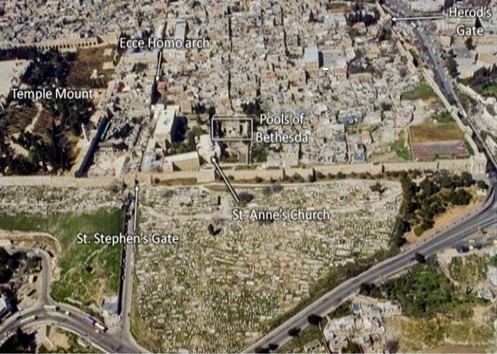
The image above shows that the location of this pool, where the disabled gathered. It was close to the Temple and the nearby Sheep Gate that enabled easy access to the Temple Mount with animals chosen for sacrifices.[4]

2 Now there is in Jerusalem near the Sheep Gate a pool, which in Aramaic is called Bethesda, and which is surrounded by five covered colonnades.

3 Here a great number of disabled people used to lie—the blind, the lame, the paralysed.

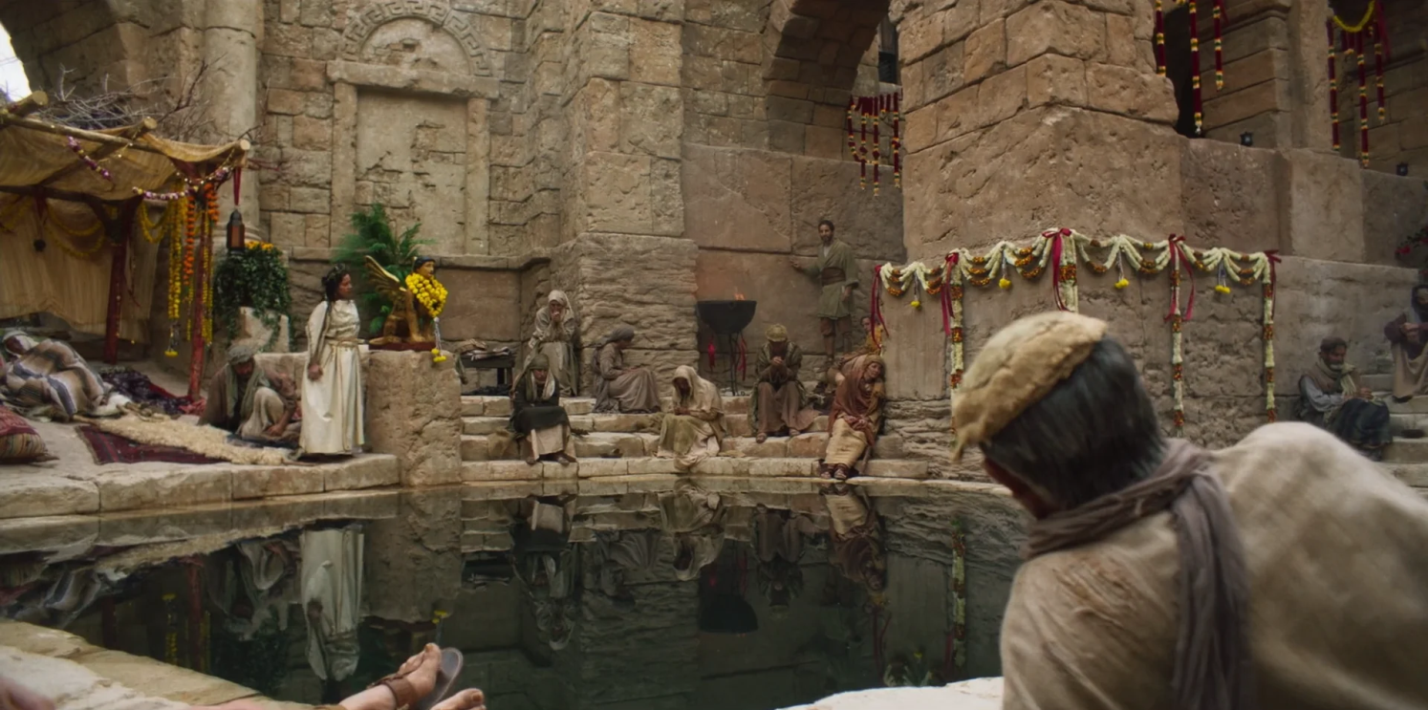
The artist impression below of the pool is scant in its depiction of the number of sick surrounding it. John describes the number of disabled people as a multitude, using the word πλῆθος (pléthos).[5] It was a ‘full house’! Therefore, many sick present around the pool would have witnessed the impending healing of the lame man by Jesus.

Pool of Bethseda

The invalid

5 One who was there had been an invalid for thirty-eight years.

John is careful to note the degree of the invalid’s disability by emphasising the length of his suffering, not just the nature of it – 38 years of losing hope. His need was great. His expectation of a miracle was most likely low. His hope for a normal life enjoyed by all ages of healthy people had probably faded into nothingness. The watching disciples possibly felt pity for him being like that for the rest of his life. Hopeless. Have you ever seen a disabled person with a look of hopelessness on their face and felt pity for them in their struggle to gain purpose in their life?

The miracles of Jesus the disciples had witnessed so far had short time horizons, e.g., turning water into wine as soon as the supply of wine needed to be replenished to maintain wedding festivities, and the instant healing of the son of the desperate official the moment he believed. In this case, the long timeframe of the invalid’s suffering would have made his healing even more stunning to the fledging disciples and the multitude of his sick companions watching on.

The unexpected healing

 6 When Jesus saw him lying there and learned that he had been in this condition for a long time, he asked him, "Do you want to get well?"

To the disciples and the invalid this question by Jesus would have sounded like a no-brainer. Of course this invalid would want to get well. Isn’t that obvious? Maybe not. There are many sick people who stay in their condition to extract sympathy and care they would not receive otherwise. They become mentally and emotionally familiar with their lot and dependent on it for attention and material support. It may be all they have ever known. With his question, Jesus addressed the invalid’s mindset before alerting him to the possibility of being miraculously healed. Did he want to get well? If he wanted to stay in his sad state, Jesus most likely would have moved on. The invalid’s response to the question by Jesus provided enough indication that he did not want to stay in his current condition. He was still trying for the seemingly impossible. Do you want to get well?

7 "Sir," the invalid replied, "I have no one to help me into the pool when the water is stirred. While I am trying to get in, someone else goes down ahead of me."[6]

The invalid’s response shows that he was ready for a miracle. He was still trying. He had not given up hope. We all face a need in our life at some time that seems impossible to fix. We can give up hope or look to Jesus to make possible the impossible just as this man did.

The stricken invalid was about to receive three life-changing commands from the stranger that would birth into reality the miracle he desperately needed.

8 Then Jesus said to him, "Get up! Pick up your mat[7] and walk." 9 At once the man was cured; he picked up his mat and walked.

How did John witnessing this astounding miracle know that the man was healed at once? He saw him (1) get up, (2) pick up his pallet and begin to (3) walk. The three physical action commands of Jesus were for those witnessing the miracle, as well as for the man receiving it.

Those who witnessed it fell into two camps in their opinion of the miracle worker. We still do today: those for Jesus, and those against; those wanting to clutch onto control of their life, and those willing to release it into the trust to Jesus. John immediately records the reaction of those who had developed a religious control identity and needed to maintain it. Hence, they were against the miracle, or, more specifically, against Jesus who performed it. He was an increasing challenge to their power, when doing life-changing miracles like this. Nevertheless, on this occasion the religious leaders believed they had concrete, widely recognised evidence to nail Jesus. He had commanded a vulnerable invalid to do ‘work’ on the Sabbath.

The religious attack

Standing up and walking was not punishable as ‘work’ on the Sabbath. Picking up a pallet and walking off with it was. This act fell outside the boundary of the religious authorities’ definition of permissible ‘work’. It was therefore forbidden and punishable. The authorities went after the healed invalid, who would have feared their judgement, but it was Jesus who was their real target.

The day on which this took place was a Sabbath, 10 and so the Jewish leaders said to the man who had been healed, "It is the Sabbath; the law forbids you to carry your mat."

11 But he replied, "The man who made me well said to me, ‘Pick up your mat and walk.’"

12 So they asked him, "Who is this fellow who told you to pick it up and walk?"

13 The man who was healed had no idea who it was, for Jesus had slipped away into the crowd that was there.

The warning by Jesus

Jesus had no desire to be adored or questioned about the spectacular physical miracle that had just happened. He disappeared to avoid those who witnessed it and the crowd which would rapidly build. He had not yet finished addressing the need of the invalid. His focus was not primarily on the physical condition of the invalid but on his spiritual state, as is true for all of us. So Jesus went searching for him[8].

We cannot imagine the impact on the mind and emotions the healed man must have experienced at the instance of suddenly being able to walk after 38 years of seeming hopelessness. No wonder he went to the Temple full of amazement, extreme excitement and inexpressible gratitude. I doubt that he would have slowly strolled through the Sheep Gate to the Temple. It is more likely that he would rushed and drawn the attention of many on the way. No doubt, he went to give exuberant thanks to God. Jesus knew that is where he would find him.

14 Later Jesus found him at the temple and said to him, "See, you are well again. Stop sinning or something worse may happen to you."

John records the essence of what Jesus wanted to say to the healed invalid to secure his future. Firstly, he affirmed for the invalid that he was now miraculously whole and healthy.

"See, you are well[9] again".

This was his new state. Now he could look forward to a new life with family and friends and pursue long-held dreams. What a gift to be healthy and whole again! That was secured.

Then Jesus swiftly switched the healed man’s focus from high elation to the core focus he had to face head on, in order to maintain his new life. Jesus commanded,

"Stop sinning or something worse may happen to you."

Jesus could not have been clearer with the shock treatment needed to switch the man’s focus from his emotions to his actions. This is why Jesus went searching for him. He wanted to be clear that the miracle should not be the man’s focus. His sin should.

We sin every day. We cannot stop it, yet Jesus here is commanding the man to stop. Was this a particular habitual sin that had controlled the man and had physical impacts that turned him into a cripple, and hence this firm warning? Alternatively, was Jesus addressing a common pattern that follows an unexpected encounter of our spirit or body with him. Instant amazement and heightened feelings of excitement and appreciation usually accompany our awareness of being touched and embraced by the love of God. These can fade over time as we journey back into our daily routine and mundane social interactions. Our miracle can lose its effect overtime in building a close relationship with God, if we are not focused on doing so.

Whatever the reason behind this command by Jesus, it clearly linked the man’s spiritual condition with his future physical welfare. The man could not escape the direct link between spiritual health and physical status. Nor can anyone. Sin brings various problems in every life when committed by us or against us. We all experience this reality of cause and effect between our spiritual and physical states. Over time unconfessed daily sin dulls and kills off devotion to God and open communication with him. Then spiritual sickness creates multiple expressions of physical suffering. We see it in our families, neighbourhoods, nation and the world.

How did the healed man respond to this instruction by Jesus. John is silent about that. Instead he notes that,

15 The man went away and told the Jewish leaders that it was Jesus who had made him well.

Unaware of the impact it would have on Jesus, the healed invalid provided the information the religious leaders needed to charge Jesus specifically with what they considered to be a crime.

The use of religious law

Every religion has a power structure to control its adherents and apply its laws. The Jewish leaders were quick off the mark to use this miracle to pit their authority against the rapidly growing popularity of Jesus.

Documented laws and edicts given on the fly to address a threatening situation are often used to reinforce the authority of the leaders of any religion or government. Religious laws in Israel controlled by the Pharisees and Sadducees had accumulated over centuries. Laws can even emerge from a movement that focused on love in its beginnings when a self-seeking, charismatic leader emerges with the desire to expand his influence over the adherents. A cult emerges. Love turns to control.

In this case, the Jewish leaders could draw upon an ancient law, given by God to Moses over a millennium ago to govern the twelve tribes Israel, when they were transitioning from the hardship and bitterness of forced labour under Egyptian taskmasters[10] to the freedom of emerging nationhood under the leadership of Moses. This fourth law of the Ten Commandments engraved on stone tablets by God and given to Moses was very clear:

Remember the sabbath day, and keep it holy. Six days you shall labour and do all your work. But the seventh day is a sabbath to the Lord your God; you shall not do any work — you, your son or your daughter, your male or female slave, your livestock, or the alien resident in your towns. For in six days the Lord made heaven and earth, the sea, and all that is in them, but rested the seventh day; therefore the Lord blessed the sabbath day and consecrated it.

(Exodus 20:8-11)

The lengthy description of this law, compared to the other nine commandments engraved by God heightened its importance, which has continued through the centuries. Many Jews are particular in keeping it, even while being careless about some of the other nine commandments given by God to Moses. The Sabbath law in the Ten Commandments is carefully honoured today by Jewish families in Israel and around the world. I observed this in the 2 weeks I spent in Israel. With no work on the Sabbath, families gathered in parks having fun together. On Friday night I was approached by the young husband and father of the Jewish family with whom I found lodging for a week. He instructed me to decide what light I wanted on during Saturday. I had to switch it on before Friday ended, because to use a switch on Saturday was ‘work’ and breaking the Law. Thus even the smallest physical effort is apparently still considered ‘work’ by Jews today living in Jerusalem.

But the seventh day is a sabbath to the Lord your God; you shall not do any work.

The definition of work

How ‘work’ is defined by the different branches of Judaism and its households has varied a little over time.

The critical question about the invalid’s healing is: "Did the definition of work in the 4th commandment, as understood at the time of Jesus, preclude an invalid of 38 years being healed and commanded to pick up his sole possession to walk into a new future? Definitely so according to the religious power structure, but apparently not so to Jesus. Clearly, he did not see picking up a camp-bed to be ‘work’, otherwise he would not have commanded the healed invalid to do it.

So what else did Jesus exclude from the 4th commandment’s definition of the work that the religious leaders would not permit on the Sabbath?

The clarification by Jesus

The answer is found in a later deliberate challenge to the Pharisees’ definition of work made by Jesus performing another healing. This time he chose a synagogue where the exercise of the rulers’ religious authority over devout Jews was preeminent. Since the healing of the lame man on the Sabbath, the rulers had begun a concerted effort to hound Jesus wherever he went to build their case for his death.

Jesus could not have chosen a more confronting place to challenge the definition of ‘work’ by religious leaders assigned to tag him for the day. Mark 3:1-6 records the confrontation and its result:

1 Another time Jesus went into the synagogue, and a man with a shrivelled hand was there.. 2 Some of them were looking for a reason to accuse Jesus, so they watched him closely to see if he would heal him on the Sabbath. 3 Jesus said to the man with the shrivelled hand, "Stand up in front of everyone."

4 Then Jesus asked them, "Which is lawful on the Sabbath: to do good or to do evil, to save life or to kill?" But they remained silent.

5 He looked around at them in anger and, deeply distressed at their stubborn hearts, said to the man, "Stretch out your hand." He stretched it out, and his hand was completely restored. 6 Then the Pharisees went out and began to plot with the Herodians how they might kill Jesus.

This public miracle set the stage for the authorities to justify hatching a plan to murder Jesus that ended at the Cross.

What then do we learn from this encounter with the religious authorities how Jesus viewed ‘work’ on the Sabbath?

  1. Focus on your heart not law

    The passage shows how the deliberate and very public face-to-face public challenge made by Jesus to the Pharisees exposed their hardened religious hearts to the devout worshippers present in the synagogue. It shows that for Jesus the issue was not about the physical boundaries of the definition of work in the 4th Law commandment, but rather about the state of the hearts of those seeking to honour God by keeping this commandment. This is true for any behavioural rule we may set for ourself. Think of a rule you have set to feel good about achieving it, then ask the question, " Where is my heart when obeying my rule?" Is it applauding my self-righteousness or alert to any negative impacts on others?

  2. Love triumphs over law

    Jesus intensified his synagogue challenge to the Pharisees’ motivations by heightening the visibility and presence of the man with a shrivelled hand. He commanded him to stand up, not in a second or third row but in front of everyone. Then using the man’s condition, which was not life threatening, Jesus set up a theoretical test for the Pharisees that would expose their lust for power over people and public self-aggrandisement. His theoretical test posed two examples that set in juxtaposition opposing choices for acting lawfully on the Sabbath. The choices were between unmistakable extremes of action: good or evil, rescue or murder.

    4 "Which is lawful on the Sabbath: to do good or to do evil, to save life or to kill?"

    It was clear what a righteous and loving heart would choose, and what an evil self-centred heart would choose. No wonder the Pharisees would not answer the question. They were caught in no man’s land between affirming healing as ‘work’ on the Sabbath or denying it. They were focused on themselves and not the man in need. Mark records that the state of their heart angered and deeply distressed Jesus – possibly because Jesus saw that they had no love for anyone but themselves – so he took action.

    5 He looked around at them in anger and, deeply distressed at their stubborn hearts, said to the man, "Stretch out your hand."

    The miraculous healing of the shrivelled hand in the synagogue demonstrated to all present the supremacy of healing love over law. The test set up by Jesus aimed to show that healing love triumphs over law.

  3. Pride empowers law and divides

    When ego power is embedded in the administration of religious or governmental law, acts of love are consistently dismissed, as illustrated by the instant response of the Pharisees:

    6 Then the Pharisees went out and began to plot with the Herodians how they might kill Jesus.

    The immediate response of the Pharisees to plot the death of Jesus demonstrated that their hearts were encased in evil that would kill. The laws they controlled held supremacy over love, It enabled them to control a large range of activities, which they included in their ever expanding definition of ‘work’. Any challenge to their control over the people through the administration of their laws had to be removed, viz., Jesus in this case. By association, the man with the shrivelled hand became a pawn in the Pharisees’ plan to remove Jesus as a threat to their authority. They had no heart for the invalid. They had no capability to share in his exploding joy. Entrenched investment in their power as the ‘police’ of their laws had long destroyed any ability to empathise with the miraculous happening in their full view. Their elevated pride as protectors of their laws had killed off compassion. It can also kill off ours. Elevated pride in our journey’s successes always does.

    Pride will cast love aside and use anyone who is suitable to be used to demonstrate and reinforce authority in politics, and even in the smallest group in society. One example is people who become pawns in the power struggle of debates. Fracturing power-seeking debates in any religion, political forum or group will continue so long as pride exists in the human race. Examples run through history until the present day.

    One of the most distressing cases of this phenomenon is its occurrences in church leaders, who extol Jesus as the Saviour of the world, yet continually seek to expand their power base using their flock in a variety of ways over a variety of issues. Why is this distressing? Because Jesus came to serve and not to use, to die for the least of all, and he commanded his followers to love the least just as he had demonstrated in his life:

    My command is this: Love each other as I have loved you

    (John 15:12)

    Jesus commands to love measured by the benchmark of his consistently demonstrated love. His pinnacle act of love submitting himself to the sufferings of the Cross became the benchmark for the behaviour of all humanity. It triumphs over any other law or purpose. The law of love demonstrated by Jesus is the measure that must be applied to my behaviour and that of every ambitious leader.

    John now shifts his focus to record the growing warfare of religious law against love.

The beginning of persecutions

16 So, because Jesus was doing these things on the Sabbath, the Jewish leaders began to persecute him.

John uses the imperfect tense of the Greek word διώkω (diókó), which translated means to pursue continuously. To pursue a person continuously, with the aim of putting them to flight, is by implication, to persecute. Sometimes media can be described as persecutors of their targets, who they hound to capture the latest story that sells. John’s description of the Jewish leaders’ behaviour towards Jesus after viewing the healing of the man at the pool is that of continual harassment and hounding of Jesus wherever he went. They put him under constant watch so that they could use his every move to build the case against him needed to justify their kill.

Jesus used diókó to describe the persecution of any who choose to be associated with him, as well as the persecution of the prophets by the power structure of their day that ended in their kill.

11 "Blessed are you when people insult you, persecute (diókó) you and falsely say all kinds of evil against you because of me. 12 Rejoice and be glad, because great is your reward in heaven, for in the same way they persecuted (diókó) the prophets who were before you.

(Matthew 5:11-12)

Therefore, διώkω (diókó) could be applied to every martyr of the Gospel since the death of Jesus. They were all persecuted, Death culminated their persecution for declaring that Jesus is the Lord of creation. Ejection from our social group and persistent rejection is the ‘death’ many followers of Jesus face today from those who won’t entrust the control of their lives to Jesus.

diókó underlay Dietrich Bonhoeffer’s understanding of ‘costly’ grace versus the ‘cheap’ grace that was being preached from Germany’s pulpits leading up to the rise of Hitler. Bonhoeffer proclaimed that we are called to ‘costly’ grace when we choose to follow Jesus. For him, ‘costly’ grace leads to persecution, It formed the basis of his saying,

"When Christ calls a man, he bids him come and die"[11]

He chose to die rather than preach ‘cheap’ grace that fosters applause from followers and accumulation of wealth as displayed grossly by some current preachers.

Preachers of ‘cheap’ grace today build their following and personal wealth by focusing their teaching on material prosperity promised by God to those who give their lives and finances to him believing they will be rewarded, Bonhoeffer would ask, "Where is costly grace in your preaching?" Bonhoeffer’s understanding of ‘costly’ sustained his unequivocable speaking out against Hitler until his martyrdom on 9 April 1945 by the Gestapo as they hurriedly executed their prisoners as the Allied forces approached and ended the war 29 days later.

The possibility of persecution continues to test the strength of every person’s commitment to Jesus today. Am I willing to be persecuted in my various social groups for the sake of promoting Jesus as Lord of all? Am I prepared to die to popularity and acceptance? Do I revert to sharing forms of ‘cheap’ grace in my social network, while others are literally dying for preaching Jesus. The potential of diókó for followers of Jesus tests whether or not we cower to opposition of the Gospel by promoting a ‘cheap ‘ grace or maintain a clear declaration of Jesus as the Saviour and Judge of all mankind. In his parting instructions to his disciple Timothy, Paul summarises to Timothy his persecutions as an example of ‘costly’ grace. He reinforces the truth to Timothy what will happen to the person who lives for Jesus.

12 In fact, everyone who wants to live a godly life in Christ Jesus will be persecuted

(2 Timothy 3)

Bonhoeffer would say this similar to Paul,

…everyone who wants to live a life of costly grace in Christ Jesus will be persecuted

Satan does not want his deluded captives to hear the message of Jesus that can set them free. As it was for Jesus, so persecution continues for his followers. It continues today for every follower of Jesus who does not slide into silent ‘cheap’ grace but commits his life to ‘costly’ grace.

16 So, because Jesus was doing these things on the Sabbath, the Jewish leaders began to persecute him.

The defence

John records how Jesus responded to his persecutions by the religious leaders so that future disciples see how to respond to the attacks of those who reject Jesus as the Lord and Saviour of all mankind. Notice the defence by Jesus:

17 In his defence Jesus said to them, "My Father is working to this very day, and I am working."

1. Work is defined spiritually

Jesus did not avoid the topic of ‘work’ on the Sabbath for which he was being accused. He defended his command to the invalid to take up his mat and walk by elevating the definitionof work from the physical realm to the spiritual. To the Pharisees, work was fully defined in the physical realm. They could measure that work and police it to maintain their control of the people. They had jettisoned any spiritual meaning of ‘work’.

To Jesus, however, work is more than lifting a mat on the Sabbath. He defines it as the continual release of the Father’s life-giving power into his creation. It is life-giving work that originates in the Father.

17 … "My Father is at his work to this very day, and I too am working."

The Father is working every moment and every Sabbath. His work is the eternal release of the creative life of his Spirit throughout humanity. Thus, it is Spirit-empowered, life-giving work that is initiated by the Father and sustained by him. He is still working today releasing his Spirit and power into humanity to bring dead spirits alive and always will.

2. God is defined by relationship

"… and I too am working."

The life of the Father as the eternal Spirit dwelt in Jesus the Son as indivisibly one with the Father from eternity past. This creative spiritual life of the Father empowered the obedience of Jesus the Son to follow the workings of the Father in him, As the Father does his Spirit-empowered life-giving work, so Jesus the Son also does, being empowered by the Spirit of the Father acting as one with him releasing his spiritual life into his creation. In this manner, Jesus is the face of the Father to creation and the channel of his Spirit releasing the Father’s creative life energy into creation.

Hence, just as the Father is still working, so too Jesus is still working and always will be. His life-giving work has always been, and continues to be, released uninterrupted by the Spirit of the Father in him. The Father initiates that work, the Son imitates by always doing what the Father is doing. They are intimately and indivisibly one at work. They invite us into that spiritual work in unity with them. The Father initiates, the Son imitates, and so too many sons who are born by the Spirit imitate the Father and his Son Jesus as the Spirit empowers it all.

Consequently, the Spirit today is still releasing the promises of the Father and Jesus into those followers, who are fostering intimate relationships with God through Jesus. God’s work of releasing his life has no end, even in the new heaven and new earth created to displace the current creation flawed by sin. He will release his life for eternity, because he is life and he is eternal.

This eternal spiritual work of God is way above and beyond any physical work. Therefore, no law can define it. No law can contain it. This spiritual work eternally preceded physical creation, including the physical creation of the 4th commandment in the Law etched by God at a moment in time on tablets of stone given to Moses. Hence, the Pharisees could never define this spiritual work of God in physical terms nor police it. Their hunger for power made them blind to it.

18 For this reason they tried all the more to kill him; not only was he breaking the Sabbath, but he was even calling God his own Father, making himself equal with God.

The Pharisees now had the ultimate blasphemy handed to them on a plate, which they could pin on Jesus and justify his execution. He had not only broken the 4th commandment by directing the healed invalid to do work picking up his pallet on the Sabbath, he was also breaking the 1st and 3rd commandments by claiming Yahweh as his Father.

The 1st commandment: "You shall have no other gods before Me." (Exodus 20:3)

Jesus did not challenge the Pharisees’ accusation that he was making himself equal to God, because he was God from eternity past. The Pharisees had no idea that Jesus was divine, even though he was constantly performing astounding miracles. They were blind to his deity. Hence, they would have also considered him guilty of the 3rd commandment.

The 3rd commandment: "You shall not misuse the name of the LORD your God, for the LORD will not hold him guiltless who misuses His name." (Exodus 20:7)

Likewise, Jesus had not misused the name of the LORD[12] in vain, because he was Yahweh. He later declared emphatically to the Pharisees that he was the eternal I AM. (John 8:58) Some of them would discover that reality one day and turn to trust in him. The religious zealot Saul, (renamed Paul), was one, Nicodemus another. They were prepared to die for that truth. People are still dying for it today. Others are trying to displace it or kill it.

The relationship between the Father and the Son

18 For this reason they tried all the more to kill him; not only was he breaking the Sabbath, but he was even calling God his own Father, making himself equal with God.

Having given the Pharisees ammunition to kill him by making himself equal to God, Jesus now clarifies the relationship between himself and God, who the Pharisees believed they were representing, and whose name they claimed to be protecting.

Jesus begins his explanation forcefully.

19 …"Very truly I tell you…"

In today’s vernacular, "Pay attention. I am speaking truth to you", which implies, "So listen carefully and put all your rushed false judgements of me aside". Every person debating the identity of Jesus must take heed of his claim to speak the truth. Few do. Most give a flippant look at Jesus rather than carefully investigate his identity defined over 1,500 years of revelations prior to his time, and those documented over three years interacting with his followers every day. There is much evidence to review to form an accurate picture of Jesus. Because of its importance, for 40 days after his resurrection and before his ascension into heaven, Jesus took his disciples through that 1,500 years of evidence in their scriptures. There is no valid excuse for ignoring it.

So what is the fundamental description Jesus himself gives to his identity? He is the Son of the God of history as revealed in the Old Testament scriptures. This God is his Father, and he is his Son. This was an astounding blasphemy to the Pharisees just as it is to major religions today. So how does Jesus proceed to describe how this supposed Father-Son relationship operates?

Every person seeking to understand the identity of Jesus must take into account his following claim,

19 … the Son can do nothing by himself; he can do only what he sees his Father doing, because whatever the Father does the Son also does.

We have to consider carefully this claim by Jesus on how his relationship as the Son worked with his Father. Jesus characterises this eternal relationship as:

1. Perfect imitation

The first truth Jesus revealed to the Pharisees about his relationship to their God is that he is not the initiator of his actions and teaching, which they were judging. The God of their history is the sole initiator, as he has been of all existence. Therefore, in judging Jesus, the Pharisees were uttering blasphemy judging the actions of their God Yahweh and not those of Jesus. What they were seeing done by Jesus was initiated by their God. He creates life and raises the dead.

…the Son can do nothing by himself; he can do only what he sees his Father doing, because whatever the Father does the Son also does.

If the Father creates all life, what does the Son do? Jesus describes himself as a Son who merely imitates what his Father initiates, To paraphrase his teaching,

"Pharisees, whatever miracles you see me doing, and whatever teachings you hear me giving are not initiated by me. I am an imitator. I am a perfectly accurate imitator of Yahweh. I can do nothing by myself: ‘whatever the Father does the Son also does‘ forever. Therefore Pharisees, carefully review what I have been saying and doing, and you will begin to gain an accurate image of the God of your venerated leader Moses, who carried the commandments given by my Father down from the mountain. Look at me and you will see your God, who gave those commandments and you claim to follow".

The same is true for every person today who wants to make a worthy assessment of the identity of Jesus. Time must be given in our journey to truth to investigating his historically verifiable actions and teachings and arrive at a conclusion about his full identity. This is to study him as revealed in both Old and New Testaments of the Bible. It is why the individual or religion that rejects Jesus, as revealed in the Bible’s prophecies and records of his life, cannot claim to love the God of creation as recorded in the history of salvation in the Bible[13]. They love a god created into an image that suites them.

Jesus is the perfect imitator of God. Hence, to reject Jesus the Son is to reject the Father he imitates accurately and obeys fully. To honour and obey Jesus the Son above any personal philosophy or devotion to any other entity is to honour the Father who he imitates. To honour and venerate any other religious leader or philosophy above Jesus and excluding him is to dishonour the Father and Creator of all existence with whom his Son Jesus is one. Therefore, it is paramount that we test who we honour and have chosen to follow, and test our basis for doing so.

2. Unlimited intimacy

What made his perfect imitation of the Father possible? Jesus explained,

20 For the Father loves the Son and shows him all he does. Yes, and he will show him even greater works than these, so that you will be amazed.

The perfect imitation of the nature, works and teachings of the Father by Jesus was driven by his Father’s eternal love for him. Jesus explained that the Father loves the Son and continues to show[14] all he does from his love for the Son. He holds nothing back. Nothing is hidden from the Son, including the Father’s plan for each person. The process is a continuous journey and never stops.

Therefore, if we want to know God’s plan of love for our life each moment, we have to seek intimacy with Jesus, because the Father has revealed all of the plan for our life journey to him. Every person is part of the total revelation of all God’s plans shown to Jesus. When we seek the intimacy with Jesus that he has with the Father, he enacts the Father’s plan for us put into his trust by the Father.

Divine intimacy is, therefore, at the heart of all that God does on earth through Jesus. The result was that the miraculous physical works of Jesus amazed those who witnessed them. They came from the heart of the Father who releases his creative power to control the quanta in all creation unbounded by time and location. Amazing!

Jesus has already sacrificed his life on the Cross to create the pathway for our unlimited intimacy with God. He has already taken the judgement of his Father on our sin, so that his Spirit can dwell within us to develop intimacy with our spirit. We have access to unlimited intimacy with the Father through the Spirit of Jesus dwelling within us. Through him, we have access to God’s plan for our journey each day, which has been revealed to Jesus. Miracles result as we focus on increasing our intimacy with the Father and the Son through his Spirit dwelling in us, because then he implements his plan in us and through us. His plan is to renew life and beauty in his creation corrupted by Satan. We join in this renewal by seeking intimacy with the Father, the Son and the Spirit via the pathway established by him, Then he does works in and through us that amaze us.

For the Father loves the Son and shows him all he does. Yes, and he will show him even greater works than these, so that you will be amazed.

3. Amazing resurrections

21 For just as the Father raises the dead and gives them life, even so the Son gives life to whom he is pleased to give it.

Jesus continues to explain that the result of the unlimited intimacy of the Father with the Son is the giving of life to the dead. He gives life to whoever he chooses. Is Jesus describing a physical or spiritual act by the Father? In other words, are the ‘dead’ physically dead or spiritually dead? Are they physically raised to life or spiritually? Hence, is the life that Jesus gives to whomever he is pleased to give it, physical or spiritual?

Physical resurrections

When we look into prior history we find examples where God physically raised the dead through his servants. Elijah brought the dead son of the widow at Zarephath to life (1 Kings 17:17-24), and Elisha, as the successor of Elijah, some years later, brought the dead son of the Shunammite woman back to life (2 Kings 4:28-20). If these Old Testament prophets were used for physical resurrections, why not Jesus?

National resurrections

Ezekiel, the prophet of Israel in his day, is given a vision by God of a valley of dry bones representing wayward Israel and told to prophesy that God will resurrect them from their graves and return them to their promised land. (Ezekiel 37:12-14)

12 Therefore prophesy and say to them: ‘This is what the Sovereign Lord says: My people, I am going to open your graves and bring you up from them; I will bring you back to the land of Israel. 13 Then you, my people, will know that I am the Lord, when I open your graves and bring you up from them. 14 I will put my Spirit in you and you will live, and I will settle you in your own land. Then you will know that I the Lord have spoken, and I have done it, declares the Lord.

Certainly, Israel has returned and settled in their land since this prophecy was given. Their return was not an individual physical resurrection, however, but a national restoration to their land promised by God to Abraham. It was a physical in-gathering from their diaspora in the ancient world implemented by the Allied forces in 1948. The ingathering could not be described literally as a resurrection from burial sites, although metaphorically it could be seen as a national resurrection to its previous land to re-establish its own governance and institutions.

Spiritual resurrections

Daniel prophesied the final resurrection at the end of time of those who sleep in the dust of the earth with some resurrected to everlasting life and others resurrected to everlasting contempt.

2 And many of those who sleep in the dust of the earth shall awake, some to everlasting life, and some to shame and everlasting contempt. 3 And those who are wise shall shine like the brightness of the sky above; and those who turn many to righteousness, like the stars forever and ever.

(12:2-3)

This prophecy describes a spiritual resurrection to a new state of existence never before experienced. The two different destinations described are everlasting. Therefore the prophecy describes a mutually exclusive spiritual state that never ends, viz., life or contempt. In this new state there is an eternal shining of beings to a brightness level never before seen except by Moses on Mount Sinai, the angel sitting at the tomb of Jesus, who dazzled all who saw him, and the brilliant light of Jesus seen by Peter, James and John on the mountain when he was transfigured.

Untainted spirit is spirit imbued with infinite energy. The untainted spirit of Jesus was spirit imbued with everlasting infinite energy. He chose the extent and timing in his journey of revealing the life of God when he would allow it to shine among observers.

Resurrections by Jesus

How was raising the dead and giving life manifested by Jesus on earth? Was it performing physical resurrections or giving new spiritual life?

Jesus raised physically:

  • a widow’s only son (Luke 7:11-14),
  • the daughter of Jairus (Luke 8:49-56) and
  • his friend Lazarus of Bethany four days after being put in his tomb (John 11).

When he chose the moment of his own death, many were raised physically from the dead.

50 And when Jesus had cried out again in a loud voice, he gave up his spirit. 51 At that moment the curtain of the temple was torn in two from top to bottom. The earth shook, the rocks split 52 and the tombs broke open. The bodies of many holy people who had died were raised to life.

53 They came out of the tombs after Jesus’ resurrection and went into the holy city and appeared to many people.

(Matthew 27:50-53)

No wonder the centurion on guard with this soldiers at the Cross, upon hearing the cry of Jesus and immediately experiencing the shaking of the earth and sound of splitting rocks, declared in terror, "Surely, he was the Son of God".

21 For just as the Father raises the dead and gives them life, even so the Son gives life to whom he is pleased to give it.

This life of Jesus operating in and through the lives of his early believers, was marked by multiple miracles. It still is today. The perfect imitation of God, as revealed by Jesus in his work and unlimited intimacy with him, created a life with miracles in the early disciples, who sought to imitate Jesus in their daily lives and build intimacy with him. Then as fellowships of believers gathered in different geographical locations, healing gifts and miraculous powers continued among them (1 Corinthians 12:7-11).

There is no greater calling than to be a life-giver, to be a rescuer from death. Once one has tasted this vocation, all others are the daily going through the motions of a lower order of purpose and existence. And when this is experienced, one’s bearing tells the story. There is no study which seeks to extend one’s mind to its outer limits, no creative expression that can equal the thrill of dispelling spiritual death and sickness from a person with the life of Jesus Christ.

4. Delegated authority

Jesus continues explaining his relationship with his Father as having entrusted to him all authority to judge every human.

22 Moreover, the Father judges no one, but has entrusted all judgment to the Son, 23 that all may honour the Son just as they honour the Father. Whoever does not honour the Son does not honour the Father, who sent him.

24 "Very truly I tell you, whoever hears my word and believes him who sent me has eternal life and will not be judged but has crossed over from death to life. 25 Very truly I tell you, a time is coming and has now come when the dead will hear the voice of the Son of God and those who hear will live. 26 For as the Father has life in himself, so he has granted the Son also to have life in himself.

27 And he has given him authority to judge because he is the Son of Man.

28 "Do not be amazed at this, for a time is coming when all who are in their graves will hear his voice 29 and come out—those who have done what is good will rise to live, and those who have done what is evil will rise to be condemned.

30 By myself I can do nothing; I judge only as I hear, and my judgment is just, for I seek not to please myself but him who sent me.

Its scope and divine purpose

22 Moreover, the Father judges no one, but has entrusted all judgment to the Son

Note that Jesus claims emphatically that it is him before whom we will appear to give account of our life, not any other religious leader or philosopher, and not even his Father. The judgement of every person on earth has been delegated to him, regardless of their culture and belief in other gods. No matter what drives the code of a particular religion, no matter what authority it gives to one or a group of leaders, all of its adherents, including its leaders, will be judged by no one but Jesus alone. They will be accountable to him.

Comprehensively, all judgement of our life will be given by him and not just certain aspects of it. The most critical question, therefore, to ask myself is, "How am I relating to Jesus today?"

Notice the reason why the Father has entrusted all of our judgement to Jesus,

23a that all may honour the Son just as they honour the Father.

This is the eternal purpose designed into the relationship of the initiating Father and the imitating Son. It will never be changed. We live or die eternally according to our alignment with honouring Jesus to the same extent as honouring his Father, Therefore, the most critical question I can ask myself for all time is, "Am I seeking to honour the Son Jesus each moment of my life and in every decision as highly as I seek to honour the Father or any other person? Am I?"

The indivisible unity of the Father and the Son, at the heart of God’s identity, is the basis for this unchangeable fact claimed by Jesus:

23b  Whoever does not honour the Son does not honour the Father, who sent him.

Fact! This claim by Jesus is a clear acid test for each person to apply to their life regardless of their current adherence to a religion or philosophy about existence and the meaning of life. The acid test is to be applied to every global or tribal religion and personal philosophy of life we have invented for ourselves, e.g., "Good blokes go to heaven, and I’m a good bloke"; "I’m OK, I have never robbed anyone" etc. The test is for those who have heard about Jesus and the saving purpose of his birth, life, death and resurrection. We can personalise it with these questions, "What is Jesus to me?" "Am I honouring him with my life?" "To what extent do my vision and purpose for life, my plans and my morals honour the Son, Jesus?" Each of us needs to ask and listen to our answers. It is easy to say that we honour Jesus without giving much thought or self-examination, simply because we consider ourself to be a good person.

Therefore, we need a sharper test to assess clearly if we are honouring him. This is the ‘trust test’:

Where there is no trust in a relationship, there is no honour.

Every person knows that to be true for their relationships in family and society. When I break trust, I dishonour. When I won’t trust another, I cannot honour them. So the pointed question to ask ourself about Jesus becomes:

"Have I entrusted my life – past, present and future – to Jesus?

"Do I trust him enough to ask him to guide my day and answer my needs?

"Have I marked out areas of my life where he is not to tread because I won’t let go of what I suspect is dishonouring behaviour?

"Do I trust his love for me enough to follow his examples of taking the least position in social relationships and conflicts? Will I be a servant to many?

If I will not entrust my life to Jesus, I cannot claim to honour him and consequently claim to honour the Father, who sent him. What is clear, none of this is talking about choosing between religions. It is solely talking about relationships, The Father has entrusted all judgement of us to the Son, so that we might entrust all our life to him and live continuously in relationship with him serving him.

Therefore, in order to shine the light on whether or not we honour God, it is critical for each one of us to examine how we have chosen to relate to Jesus. This is the immovable fact that exposes whether or not my religious words and practices of any description in any religion are a great deception to myself and others:

Whoever does not honour the Son does not honour the Father, who sent him.

Its human purpose – divine life

Having been clear about the divine purpose of the Father in giving all authority for judgement to the Son, Jesus turns his attention to the Father’s purpose for humanity in giving his life to the Son.

24 "Very truly I tell you, whoever hears my word and believes him who sent me has eternal life and will not be judged but has crossed over from death to life. 25 Very truly I tell you, a time is coming and has now come when the dead will hear the voice of the Son of God and those who hear will live.

26 For as the Father has life in himself, so he has granted the Son also to have life in himself. 27 And he has given him authority to judge because he is the Son of Man.

The Father has designed our existence so that we cannot avoid relating to the Son. I cannot. You cannot. He has all authority for our judgement in his control. With the inescapable certainty of having to face him in judgement, we would not want to avoid him in this life. That would be madness. Nevertheless, pride lacks common sense and madly marches us to eternal judgement while living in denial of it. It is paramount for every person to pay attention to the words of Jesus as the way to eternal life, in order to receive eternal life from him. How does Jesus describe paying attention to his word?

Very truly I tell you, whoever hears my word…

When it comes to spiritual truth, there is a difference between listening to it and hearing it. We can listen with closed ears. We close our mental ears to what does not suit our journey shape created to satisfy our senses and bolster our pride. Many people attend religious meetings with closed ears supported by their pride. They listen but to not hear a thing about spiritual life. They stay comfortable and immovable in their religious practice. So the wise question to ask is, "Am I open to hearing the words of Jesus?" We must be open to hear the word of Jesus then to trust the Father who sent him. Jesus stressed this critical need,

24 "Very truly I tell you, whoever hears my word and believes (trusts) him who sent me has eternal life…

When we hear and trust, we become the immediate possessors of eternal life by crossing over from our current state of spiritual death to spiritual life with the guarantee never to face judgement,

…and will not be judged but has crossed over from death to life.

When we hear and trust, we become one of the millions who have already crossed over from death to life. If we won’t trust, we won’t hear and cross over from death to life. We stay dead. John uses the Koine Greek Perfect Indicative Active tense to convey a completed action with lasting results in the present[15]. In other words, we have crossed over from our old life of spiritual deadness and separation from God’s life and now live continuously in the new spiritual realm filled with his life. We start seeing and experiencing spiritual life in all its richness. Before, we operated from a dead religion and philosophy that cannot create God’s life. By hearing and trusting we now we have God’s life within us producing its spiritual fruits, as described by Paul,

…the fruit of the Spirit is love, joy, peace, patience, kindness, goodness, faithfulness, gentleness, self-control; against such things there is no law.

(Galatians 5:22-23)

Imagine those qualities growing in your life simply because the Spirit of God within you is producing them. This is so significant that Jesus reiterates with strong emphasis how we gain spiritual life:

25 Very truly I tell you, (in other words, pay attention, this is significant!) a time is coming, and has now come, when the dead will hear the voice of the Son of God and those who hear will live. 26 For as the Father has life in himself, so he has granted the Son also to have life in himself.

We are in the time now when Jesus is exercising his power to give the divine life of the Father, which has been given to him, to those who hear and trust in Jesus. The immediate effect is that they come alive as sons of God with the life of the Creator within.

Having reiterated how we receive spiritual life through hearing and trusting him, Jesus reiterates his authority to judge.

27 And he has given him authority to judge because he is the Son of Man[16].

So as to validate his authority to judge all mankind, Jesus claims to be the Son of Man. He draws upon this title because of its origin in Daniel 7:13-14 that prophesies the authority over all nations given by the Ancient of Days to a heavenly human.

"In my vision at night I looked, and there before me was one like a son of man[17], coming with the clouds of heaven. He approached the Ancient of Days and was led into his presence. He was given authority, glory and sovereign power; all nations and peoples of every language worshiped him. His dominion is an everlasting dominion that will not pass away, and his kingdom is one that will never be destroyed".

The Son of Man described by the vision given to the prophet Daniel is not only a human being, He is also, and most importantly for us, the eternal King of a kingdom that lasts forever. When we put our hopes in any earthly government or current ruler, we are short-sighted. We limit the range of our sight by imagining the safety and quality of our life only up to our death, rather than raising our sight to an eternal timeline. The kingdom of Jesus is one that will never be destroyed, It is eternal. It began with his coming as he announced when he began his ministry in Galilee, "The kingdom of God has come near[18]. Repent and believe the good news!" (Mark 1:15)

Therefore, the time has come, and continues now, that we can choose for our journey in life to enter the kingdom where God rules in hearts and minds with love and justice. The question for every person is whether to choose to hear and trust Jesus, in order to enter his eternal kingdom now, or whether to keep rigidly the boundaries of their pride’s control, which will be taken from them at death. The choice is personal and the ramifications eternal.

Its guaranteed reliability

28 "Do not be amazed at this, for a time is coming when all who are in their graves will hear his voice 29 and come out—those who have done what is good will rise to live, and those who have done what is evil will rise to be condemned.

30 By myself I can do nothing; I judge only as I hear, and my judgment is just, for I seek not to please myself but him who sent me.

Jesus concludes his claim to be the delegated Judge of all at the end of this current creation, and to be theGiver of divine life for all who are prepared to trust him with their life, by assuring us that his judgement is just, We can depend upon his judgement not to be capricious or pernicious. We can trust it to be just, because his desire is to please his righteous Father and not himself.

…I seek not to please myself but him who sent me.

Therefore, to please his Father, he went to the Cross and stayed there being judged for all the sins of all time until he had created a clear pathway for his righteous Father to forgive us freely and give eternal life to any sinner, who is prepared to trust him enough to live within them with his grace and truth. Accordingly, every person, regardless of their past sins, now has the option to entrust their life to Jesus confidently, because he wants to please his righteous Father in how he exercises judgement and how he gives life, This aim of Jesus strips the world of all excuses for rejecting him. No excuse will be accepted by him at our judgement.

How then did Jesus make sure that his aim was to please the Father and never himself in every administration of judgement and gift of divine life? He mentally reminded himself that even as the Son of God he could do nothing that did not come from his Father.

30 By myself I can do nothing; I judge only as I hear

Jesus modelled the pathway of how eternal and restorative life operates in humanity. Its origin is the Father. Jesus positioned himself as having no power within, but only that which begins with hearing and obeying the Father’s instruction. The Father’s will was the source of his creative power, Jesus first wanted to hear his Father’s will for every situation and then obey it with full trust in him. He lived every moment in a listening posture ready to do his Father’s will.

In stark contrast, our ego will never position itself as having no power and wait for God’s instruction from a listening posture. Ego will never walk in unity with a relationship that requires surrendering what ego wants in order to listen, because it will not submit its power to another. This is why many reject Jesus before placing themselves in a place of listening. Their examination of his identity through the spectacles of beliefs developed from inputs through their physical senses remains limited and unable to see past the physical to the divine. To them, Jesus remains as merely a man who appeared in history for a time. They remain blind to him as the source of eternal life with all its spiritual qualities of love, joy, peace, patience, gentleness, meekness and self-control. Their unsurrendered ego continues to assert its desires fed by inputs from the physical world through the senses. It remains blind to the spiritual world all around it expressing the life of the Spirit of God that only an enlivened spirit can see.

By myself I can do nothing; I judge only as I hear, and my judgment is just, for I seek not to please myself but him who sent me.

Testimonies about Jesus

Having established his trustworthy authority to judge and to give life, Jesus now points his listeners to his validation by other sources.

31 "If I testify about myself, my testimony is not true."

He admits that such lofty claims of identity need validation by other dependable sources. He lists them as: 1) John the Baptist, 2) his miracles, 3) the Father, and 4) the Scriptures.

Every person who wants to understand the identity and life of Jesus has the same sources today to validate that he is the Son of God, who came from heaven on a mission of God to take the judgement for our sins, offer full forgiveness and begin a relationship of trust in God by inviting him to take full control of our life.

John the Baptist

32 There is another who testifies in my favour, and I know that his testimony about me is true.

33 "You have sent to John and he has testified to the truth. 34 Not that I accept human testimony; but I mention it that you may be saved. 35 John was a lamp that burned and gave light, and you chose for a time to enjoy his light.

The historical record of John the Baptist is still available for anyone to read today. The angel Gabriel predicted his birth just as the same angel announced the coming birth of Jesus. The two miraculous births entwined the identity and purpose of John and Jesus in announcing to the chosen people of God the arriving kingdom of God. John validated the identity of Jesus.

The Miracles

36 "I have testimony weightier than that of John. For the works that the Father has given me to finish—the very works that I am doing—testify that the Father has sent me.

History had never before, and has never since, witnessed such a multitude of miracles as enacted by Jesus as a sign of his deity. We have the biographies of Jesus by his early disciples to read about these works given to Jesus to finish on his first coming.

The Father

37 And the Father who sent me has himself testified concerning me. You have never heard his voice nor seen his form, 38 nor does his word dwell in you, for you do not believe the one he sent.

Jesus consistently presented himself as sent by the Father to do his will. He claimed to dwell with the Father, have seen the Father, obey the Father’s voice to do his will at all times etc. The clearly and consistently seen result was that his words and actions demonstrated the miraculous intervention of God in the lives of people.

The Scriptures

39 You study the Scriptures diligently because you think that in them you have eternal life. These are the very Scriptures that testify about me, 40 yet you refuse to come to me to have life.

Jesus then concludes this confrontation by the Pharisees with a pointed challenge to their flawed claim to believe Moses and to be the anointed guardians of what he wrote.

47 But since you do not believe what he wrote, how are you going to believe what I say?"

With this simple direct question, preceded by an assertive claim that went to the heart of their motivation, Jesus turns the attacks of the religious leaders back upon themselves. "You do not believe what he wrote". He unequivocally accuses them as being unbelievers of the revelations of God through Moses. He had already laid the charge against them that they refused to come to him. He exposed the intentions of their will…They were set in the cement of using their religious posturing to garrison the control of their egos from having to put their trust in God. At the core, they were alienated from God no matter how strongly they presented themselves as the guardians of the Scriptures and avid researchers of them. Jesus makes it clear to those listening that although their religious authorities were posturing as followers of the teachings of Moses, they were disbelievers of his teachings about the coming Messiah. With that evident disbelief operating in them, Jesus questioned how they could believe anything he claimed about himself from the writings of Moses. The choice of their wills was set against Jesus. They would never submit and trust. They were dead set against him. DEAD!


  1. Some manuscripts include here, wholly or in part, "and they waited for the moving of the waters. From time to time an angel of the Lord would come down and stir up the waters. The first one into the pool after each such disturbance would be cured of whatever disease they had". ↩︎

  2. This is one of the many promises made by Jesus recorded by John that provide every reader, who has an open mind, a solid foundation upon which to place the weight of their daily life and eternal destiny. ↩︎

  3. Bethesda means, house of pity or mercy. Other forms occur as Bethzatha and Bethsaida. ↩︎

  4. This is the gate where that led out to the sheep markets where lambs were sold for sacrifice in the Temple. They were washed in a pool (later called the Pool of Bethesda) before entering the Temple through only one door never to return. ↩︎

  5. pléthos (πλῆθος) meaning a multitude, crowd, great number, assemblage derived the word pléthó (to be full) ↩︎

  6. Some manuscripts include here, wholly or in part,"… paralysed—and they waited for the moving of the waters. From time to time an angel of the Lord would come down and stir up the waters. The first one into the pool after each such disturbance would be cured of whatever disease they had" ↩︎

  7. This was not like a thin mat we place on the floor of a room. It was more bulky. It was a small bed used by the poor and more like a thick padded quilt. It was a camp-bed or pallet. ↩︎

  8. John uses the word εὑρίσκω (heuriskó) which means to find or discover especially after searching. ↩︎

  9. The word used by Jesus is ὑγιὴς (hygiēs healthy, i.e. Well; figuratively, true.)) meaning sound, healthy, pure, whole, wholesome. ↩︎

  10. Exodus 1:8-14 ↩︎

  11. The Cost of Discipleship (London: SCM Press, 1948/2001), p. 44 ↩︎

  12. LORD is the English translation of ‘Yahweh’ = I AM in Hebrew ↩︎

  13. For example, Muhammad’s teaching that Allah "neither begets nor is born", in Surah Al-Ikhlas (112). Therefore he is not a father and has no son. This is a direct rejection of the claims of Jesus. (Refer to Nabeel Qureshi, Seeking Allah Finding Jesus, copyright 2014, Zondervan, p. 39) ↩︎

  14. Δείκνυσιν (deiknusin) the present indicative active form of deiknumi (to show) used to describe actions that are ongoing or habitual in the present time. ↩︎

  15. Μεταβέβηκεν, perfect indicative active tense of metabainó (μεταβαίνω) meaning ‘to pass over, withdraw, depart. ↩︎

  16. There are 82 incidences in the Synoptic Gospels where Jesus is recorded using this title. It was his way of identifying himself as both human and divine. It is the most frequent title he gave to himself. ↩︎

  17. Son of man = human ↩︎

  18. Jesus used the Greek verb ἐγγίζω meaning, "to make near, to come near" In this statement, he used the Greek Perfect Tense (indicative mood) which, according to Strong’s Concordance, expresses extreme closeness, or immediate imminence, even a presence, e.g., "it is here" In other words, Jesus was announcing at the beginning of his Galilean ministry, "the kingdom of God described by the prophets is right at your doorstep!" It remains at the doorstep of every life today. We either open the door of our life to let Jesus the King come in, or shut the door of our life to keep him out. ↩︎

John 4

  1. Meeting the Samaritan woman (Cameo 4)
  2. Introduction
  3. The meeting background
    1. Its initiating cause
    2. Its targeted cause
  4. The arresting question
    1. If you knew the gift of God
  5. Missed identity
  6. Missed message
  7. Timed message
  8. The wakeup call
  9. The true worshippers
  10. The true Jesus
  11. Healing the royal official’s son (Cameo 5)

Meeting the Samaritan woman (Cameo 4)

Introduction

John now switches his account of the journey of Jesus from Jesus teaching Nicodemus, a ruler and scholar, to a cameo of Jesus interacting with a person of opposites in several ways. Nicodemus initiated contact with Jesus in the dark so as not to be seen with him and risk losing his social status as a member of the ruling council of Israel. In this cameo, chosen by John to be a stark contrast in his journey with Jesus, Jesus initiates contact in the exposed brightness of the intense midday sun with a woman of no social status with her own people and the Jews. She had fallen with shame off the bottom rung of the religious and social ladders of her people. Consequently, she chose to draw water each day alone in the midday heat, rather than be rejected and humiliated by the women of her township drawing water at the well in the cool of the day, as was their custom. Such isolation is the lot of many used women today, particularly those homeless with young mouths to feed.

This cameo is for every person who feels disenfranchised by a specific individual, group, or even by themselves hiding the heavy burden of shame they carry within from breaking a moral standard publicly or in secret. For such a person, this cameo brings great hope. It enables us to watch how Jesus restored this isolated Samaritan woman, and then to open our heart to him for the restoration of our own dignity, purpose and fulfillment.

Hidden shame is endemic in the fallen human race. It is our primary blockage to being open to Jesus to enable him to remove it and set us free to journey in life with him. In the previous cameo, Jesus identified to Nicodemus this common blocking pattern, when he said,

Everyone who does evil hates the light, and will not come into the light for fear that their deeds will be exposed. (John 3:20)

These are intense words used by Jesus. They match the power of the blocking pattern operating within every human. We can use his precise statement to test our own stance with Jesus and test our buried reason for it. What is your stance? Is it hatred expressed by outright bigotry about him? Is it passive avoidance to avoid facing what is hidden from your past, or is it openness? Jesus does not present our reaction to him as an academic issue to debate, but a fear-driven response to admit and correct. Test if the name of Jesus raises your defence hackles and intellectual arguments, registers nothing or draws you to find out more about him. We are either attracted to his pure light or repelled by a fear and hatred of it that leads us to become bound up in our gaping net of false excuses and feel-good diversionary philosophies. This was the inner conflict being played out in the encounter of Jesus with the Samaritan woman.

This cameo shows how Jesus had to extract the Samaritan woman from her emotional prison of isolating fear and coax her into the light in order to set her free to journey again with confidence and honour. The result was that she became the first evangelist to the Gentile world. Many of her towns folk listened to her testimony about Jesus, sought him out for themselves and came to know with certainty that Jesus is the Saviour of the world (verse 42). She became an example of how stepping into the light from our hiddenness results in the light of Jesus expanding its reach further in us and then through us to free other hiding prisoners of moral failures.

The meeting background

Its initiating cause

1 The Pharisees heard that Jesus was gaining and baptizing more disciples than John, although in fact it was not Jesus who baptized, but his disciples. So he left Judea and went back once more to Galilee.

It is this situation that resulted in Jesus meeting the Samaritan woman.

Jesus was hugely popular by this time. John the Baptist had large crowds flock to him in the desert to hear his preaching of repentance, and of baptism as the public declaration of one’s inner decision to reject sins. Now his popularity with the people was being eclipsed by the representatives of his cousin Jesus. The Pharisees noticed this swift growth in popularity of the message of repentance and did not like it, even though it was prophesied in the last verse of their scriptures to be the necessary precursor to the coming of their long awaited, promised Messiah.

5 "See, I will send the prophet Elijah to you before that great and dreadful day of the Lord comes.6He will turn the hearts of the parents to their children, and the hearts of the children to their parents; or else I will come and strike the land with total destruction." (Malachi 4:5-6)

Religious leaders are well aware that popularity driven by the heart has power to create and control new beliefs in the next generation that can displace old beliefs, and new leaders that can displace existing. Popularity fuelled by positive emotional, inspirational and aspirational change wins every time over the controls imposed by unpopular religious hierarchies and politicians. We see it in the daily news reports of global, regional and local politics.

Hope for a better future is a powerful driver in the human psyche causing it to follow new pathways. The internet stirs up many followers of a variety of gurus promising a better future. The masses will grow quickly following a charismatic personality, who presents a new vision with hope of a better future. Putin knew that. Hence he jailed and then executed Alexi Navalny. Trump knows that with his MAGA movement. The Pharisees knew that. Hence, they were becoming increasingly threatened by the wind of spiritual change inspired by John the Baptist, and now by the followers of Jesus, who also were preaching the need for personal repentance.

Jesus knew that the only strategy available to the Pharisees to recapture religious control of the people was for them to remove both John the Baptist and himself from the crowds.

3 So he left Judea and went back once more to Galilee.

Jesus controlled his destiny and not the Pharisees. This was not the time for a showdown with them attempting to remove him from the crowds. He had only just begun his purpose for coming to earth. He had more spiritual reality to reveal to the people and his disciples before being captured and put to death. His disciples were not ready to grasp and declare his divine identity to the world. They were only just beginning to gain some understanding of it. So he withdrew from the enthusiastic crowds hungry for spiritual truth and the spectacle of his miraculous healings. John the Baptist, however, stayed where the religious leaders could find him engaging in his public ministry of declaring that Jesus was the Messiah and baptising for repentance. As a result, he was soon imprisoned by the religious power structure to remove him from the crowds. There he met his death.

The choice of Jesus to disappear was as deliberate as his later reverse choice to return to Jerusalem when the time was ripe to create a confrontation with the religious power structure (see John 5). His return ended in crucifixion. By then he was ready to step towards it and his disciples were ready to learn from it.

Its targeted cause

4 Now he had to go through Samaria.

Instead of by-passing Samaria – the avoidance strategy often used by the Jews of the day – Jesus chose the shorter route home to Galilee in the north. The necessity of him having to go through Samaria, however, was not primarily due to reducing his travel time and distance by-passing Samaria. Rather, it was due to the woman his Father wanted him to meet drawing water alone from Jacob’s well.

The Father’s love will take any route necessary to meet with us in our need and reveal himself as our Saviour and Helper. There are countless stories today of how his divine love has targeted individuals who have met Jesus in unusual, unplanned situations. The Father will direct his Son today to detour for any person with an open heart ready to receive him as the promised Messiah and personal Saviour. In this case, he detoured for a rejected woman. He will also for you when you open your heart.

5 So he came to a town in Samaria called Sychar, near the plot of ground Jacob had given to his son Joseph, 6 Jacob’s well was there, and Jesus, tired as he was from the journey, sat down by the well. It was about noon.

In other words, it was scorching hot. It is an interesting picture to imagine the Creator of the universe sitting down by a well in the heat of the day, because he was weary from a long trek. Yet the Creator of every mathematically governed quantum detail of the smallest structure to the largest in all creation never wearies. He still sustains it all.

Sitting for a rest at the well is a vivid example that the human body, with which God clothed himself in Jesus, succumbed to the same weariness that we do. The Creator did not clothe the sinless seed he implanted in Mary’s womb with a body possessing superhuman characteristics. He clothed his divine seed with our physical humanity fully, Walking in the mid-day sun brought on his thirst as it would anyone. This makes the previous survival of Jesus forty days in the desert without food an incredible feat of determination to achieve a goal. It required unyielding commitment to his mission to defeat every temptation of Satan and keep himself sinless for the even greater trial of his later crucifixion, which he had to endure to the end. For this higher purpose, he chose to endure his testing in the desert.

Now, in this situation as a traveller passing through, Jesus could have sat somewhere in the shade and waited for the disciples to return with food provisions from Shechem[1]. His decision to rest at Jacob’s well was, therefore, as much for the sake of the woman he was about to encounter, as it was to quench his thirst. She became his higher purpose to sit at the well and rest. She was his targeted cause for being there. So also are we, however and whenever Jesus comes to our attention. We are ‘the many’ that form his higher purpose, as he later made clear to his disciples,

"For even the Son of Man did not come to be served, but to serve, and to give his life as a ransom for many." (Mark 10:45)

He came to ransom us, to pay the price of judgement on our sins by a righteous God. Because sin cannot be separated from the perpetrator, he came to stand in our place by becoming our sin. Our sin became him, in order to ransom us from God’s judgement of the sin in us that has become us, and gift us fully with his perfect righteousness to become us.

The arresting question

6 … When a Samaritan woman came to draw water, Jesus said to her, 7 Will you give me a drink? 8 (His disciples had gone into the town to buy food.)

Jesus began his dialogue with the outcast woman with a simple request to challenge her.

This might seem like a natural and necessary question from a thirsty traveller who stops at a well for a rest. For this woman, however, it was a shocking opening question: firstly, because of her race (Jews avoided Samaritans and despised them[2]) and secondly, because she consciously carried the stigma of being a woman of shame rejected by her own Samaritan community. Yet here was a Jewish male talking to her and asking for a drink. She did not know who he was. Accordingly, she responded,

9 "You are a Jew and I am a Samaritan woman. How can you ask me for a drink?" (For Jews do not associate with Samaritans.)

Her response to the request from Jesus was to disqualify herself for what she considered to be a valid reason. As is usually the case, Satan puts superficial barriers between us and the giver of eternal life. He erects them in our soul, i.e., in our mind and emotions. As a result, we may see Jesus as superior and unapproachable and ourselves as low and outcast. We may see our very being as unacceptable by any measure of consistent goodness, whether that be in Jesus, or in any person we perceive to be consistently honourable and potentially shocked by our failures. This woman would have felt this intensely, because, without a doubt, she would have felt three counts were against her in this coincidental meeting with a Jewish stranger, i.e., (1) her race, (2) her gender and (3) her corrupted personal history marked by the repeated visible failures of her heart choices of a husband.

Jesus was fully aware of these factors intersecting this woman’s thoughts and emotions and how they caused her to consider herself having no dignity or value in her society, and certainly none to a male Jewish stranger. Jesus cut through these barriers of unacceptability she had erected with a jolting statement.

10 If you knew the gift of God and who it is that asks you for a drink, you would have asked him, and he would have given you living water.

He offered her a gift with life in it, when she felt that she had no life. He also does so for us.

If you knew the gift of God

The woman may have received this confronting comment by Jesus as a derogatory judgement of the extent of her knowledge about God, viz., it was deficient! "If you knew…you would have asked".

  1. If only we knew the gift of God… we would instantly discard our fears and prejudices against God and receive his gift with open arms, or more correctly, with and open heart. We would also stop repeating to ourselves all the barriers we consider disqualify us for any good fortune from God. We would no longer consider ourselves more unworthy in comparison to others who claim to have received his gift.

    How so? Because the gift of God to know about is his enduring love and his offer of it to everyone regardless of race, status in life or moral history. All of us qualify until we disqualify ourselves by rejecting him.

    His love is a gift of living water forever quenching our thirst for meaning. How can this be? It quenches forever, because his love is empowered by his life, which is forever, It has no boundaries in time. Furthermore, remember that it has no boundaries of choice. His love is for all races and all individuals. It has no favourites. It is full of grace, No one is lower than the person they perceive to be the highest. You are not. Certainly this Samaritan woman was not. Jesus stopped to give her time. He lived what he taught his disciples: "the last will be first, and the first will be last" (Matthew 2:16).

  2. If only we knew who it was that offered us this gift … we would not hesitate to ask for it urgently and enthusiastically. Who is this stranger called Jesus making this statement? How well have I examined his identity? To what extent does he remain a stranger to me? Here is the penetrating question calling for our honest response: "Why does he remain a stranger?" If we prioritised some time to investigate who he is, if we examined how he gave his love, which culminated in taking upon himself the judgement for our sins, we would stop holding up a barrier of distinction between our sinful failures and his sacrificial love for every one of us, with none excluded.

    Typically, we don’t know who is offering us the living water of eternal life, because we know little about God’s character of love pursuing us, and we know little about Jesus as God’s love in pursuit of us. Most people have spent little time reading God’s Word to learn of the character of God and the depth and relentlessness of his love searching throughout the human race from its beginning searching for those who will love him. The Bible traces the relentless search of God’s love from past centuries into the prophesied future for those open to receive it, culminating in the creation of a new heaven and earth, where sin will no longer exist to divide, and only love will reign. Who in their right mind would reject such love? Who would reject such a free gift? Who would choose a destiny absent of all love and filled with chaos instead? Are you for some unjustifiable emotion-based prejudice?

    Furthermore, if we had exposed ourselves to investigating God’s many expressions of relentless love found in the current journeys of a vast array of individuals, who were in self-made dire straits until the love of Jesus reached them, then we would no longer consider ourselves unworthy to receive his love. In short, because we have scanty knowledge of the character of the one who is offering living water as a free gift of his love, we hesitate to trust him and doubt his acceptance of us. The cause of our misguided opinion rests with us failing to investigate Jesus with an open mind. It does not rest with him. Tragically, we choose far lesser temporary substitutes to find meaning and fulfillment for our journey instead of choosing the only eternal love that can continually quench the thirst of our heart.

    Look closely at the weary Jesus, and remember that all his weariness and all his sufferings were for you as much as any previous or current follower of him. He earnestly wants to give each of us the eternal water of life and save us from our path of ultimate destruction at death. We can therefore urgently ask for his free offer of living water to quench our deepest thirst. All of us can. There are no barriers at all within him to give it. The barriers are within us, not him, He urgently wants to give us his living water of life and to free us from our burden of sin and the consequential separation from God and others it has caused. He wants to give us eternal life now, his life to our spirit now, spiritual life to our spirit now, so that we can live abundant life now, for which he made us and intended us to enjoy. This is what he wanted for the Samaritan woman.

    10 If you knew the gift of God and who it is that asks you for a drink, you would have asked him, and he would have given you living water.

Missed identity

The woman completely missed the spiritual reality of the gift of living water Jesus was offering her, possibly because of her shamed mind-set. Instead she remained focused on the physical reality confronting Jesus to be able to draw water from Jacob’s well.

11 "Sir," the woman said, "you have nothing to draw with and the well is deep".

Her physical observations were correct. Jesus did not have a receptacle to fill with water, and the well was potentially up to 55 meters deep at the time[3]. That is deep! Who was this stranger making such a bold claim of recovering water from this depth with no means of doing so? The impossibility of his claim naturally led her to search for alternatives.

Where can you get this living water?

If she really wanted an answer, she would have waited for Jesus to respond, but instead she pivoted to turn the claim of Jesus into a competitive comparison of his identity with Jacob as the revered father of both Samaritans and Jews. She switched from the focus being on her spiritual state to have a religious debate.

12 Are you greater than our father Jacob, who gave us the well and drank from it himself, as did also his sons and his livestock?"

Jesus ignored her attempted diversion, as he does with every person who takes a quick step sideways to avoid confronting who they are before the eyes of the Holy One. Our intellectual debates serve the purpose of side-stepping. We are each very conscious of our diversions and attempts to keep our distance from Jesus. We retreat from our heart and its fears of exposure into our head, He is fully aware of our closed heart’s direct rejection of his offers to come to him for eternal life. Nevertheless, as with this woman, Jesus stays on message with us until we surrender our will to his, or we die devoid of eternal life and love.

Missed message

Staying on message, Jesus answered,

13 "Everyone who drinks this water will be thirsty again, 14 but whoever drinks the water I give them will never thirst. Indeed, the water I give them will become in them a spring of water welling up to eternal life."

What a message! What an offer! Who would not want a perpetual quenching of their inner thirst for meaning and relevance in their life, particularly if it continues into eternal life? Who would not want this quenching arising perpetually from within themselves, to be there when they awake and when they switch out the bedside light at night?

Who would not want this? The answer is simple: those not ready for it. So who are they?

These are individuals who want to stay living in their self-controlled physical world of reality, which they mistakenly believe they can control. In that physical world, however, where we seek answers to satisfy our hunger for meaning and purpose that are assembled solely by inputs from our physical senses, we continually thirst. None of our attempts to satisfy our thirst drinking from "physical" wells ever lasts. When the capacity of the well we have chosen to satisfy our inner needs dries up, our only option is to find another, which also finally loses its capacity to satisfy the thirst of our soul. Then we go looking for the next well to stimulate or ease our life, e.g., a new job, a new relationship, a new investment, new pub, new club, new sports team, new drug, new good cause, new religion etc. We never arrive at eternal life welling up from within us providing a constant stream of inner satisfaction. Rather, our thinking, feeling and understanding remain encased within physical descriptions of cause and effect in our life and those we may seek to help, e.g., psychological explanations of causes in our childhood affecting mental and emotional health in our adulthood etc. As a result, we function in family and social life with bland physically-based explanations but not with the living water of a drinking spirit that can bring us alive perpetually. We miss out on never thirsting again, because we will not go to Jesus, who is the sole source of water that wells up into eternal life. He is that eternal life offering to forge a union within us, bound to our spirit by his perfect love.

The Samaritan woman missed the message, because her focus remained on her physical self, viz., on her physical thirst and on the repetitive physical effort she had to exert to acquire physical water.

15 The woman said to him, "Sir, give me this water so that I won’t get thirsty and have to keep coming here to draw water".

She missed entirely that Jesus was talking about a spiritual phenomenon not a physical need requiring physical effort to access. She seemed deaf to the reality of eternal life welling up from within one’s being perpetually quenching inner spiritual thirst for meaning and growth.

The question for each of us is: "Am I stuck in my comfort zone of being in sole control of my physical world, while missing the free offer from Jesus of everlasting life he wants to release from within my spirit now and throughout eternity?" This must be the biggest miss in life that anyone can make. Are you making it? For this reason, Jesus picks his timing to jolt us into becoming aware of our need to find living water that lasts perpetually and quenches the depths of our inner being. It is then that he reveals himself as the living water for our thirsty soul and our source of inner rest.

28 "Come to me, all you who are weary and burdened, and I will give you rest. 29 Take my yoke upon you and learn from me, for I am gentle and humble in heart, and you will find rest for your souls. 30 For my yoke is easy and my burden is light." (Matthew 11:28-30)

Timed message

Now was the time to jolt the Samaritan woman into new awareness of who was talking to her. Now was the time to shift her from surface physical thinking to buried inner need. Therefore, Jesus suddenly threw out a challenge that went to the state of her soul and opened up the possibility for honest dialogue about her core identity. A large component of our identity formation is the health of our closest relationships. Accordingly, Jesus threw out the challenge,

16 "Go, call your husband and come back."

17 "I have no husband, " she replied.

It would be interesting to know what was in her mind as she gave this instant response. Was it, "I have to dodge this one. I don’t want him finding out the failures in my private life. I am not married to my current partner according to the standard definition of my society. On that score, I can answer truthfully that I have no husband". This was a half-truth, however. The other half exposed her moral failure, which she kept hidden. She was in a relationship with a male, presumably an intimate one, if her marital history was any indication of that likelihood. Her answer was an attempted deception. How easy this is to do about any matter where we try to hide our wrong from others and ourselves!

Note the response of Jesus. It was time to give this woman a wakeup call, viz., an instant exposure of her private life to a stranger that left her nowhere to hide.

The wakeup call

17 Jesus said to her, "You are right when you say you have no husband. 18 The fact is, you have had five husbands, and the man you now have is not your husband. What you have just said is quite true."

Jesus did not mince words. He jolted her suddenly with the facts, He shattered her mirage. It was the time in their interaction to expose the truth of her situation. "How does he know these facts about my personal life?" Imagine being drawn by a total stranger into a discussion where they first of all insult your lack of knowledge about an unfamiliar topic,

If you knew the gift of God and who it is that asks you for a drink…

Then you respond defensively to their apparent boast by attacking their status,

Are you greater than our father Jacob, who gave us the well and drank from it himself, as did also his sons and his livestock?"

Then they apparently offer a way to lighten your physical and social stress,

13 Jesus answered, "Everyone who drinks this water will be thirsty again, 14 but whoever drinks the water I give them will never thirst. Indeed, the water I give them will become in them a spring of water welling up to eternal life."

That sounds appealing to you, so you respond accordingly focused on its physical benefits unaware of its spiritual nature,

15 "Sir, give me this water so that I won’t get thirsty and have to keep coming here to draw water"

Then, before you know it, they suddenly tell you more about yourself than you want known,

17 "You are right when you say you have no husband. 18 The fact is, you have had five husbands, and the man you now have is not your husband. What you have just said is quite true."

Totally exposed. No escape. "The fact is." That is how it is with Jesus. The time comes for everyone when he decides to shine his light on our hidden life. Jesus turns our preoccupation with physical existence to focus us on spiritual necessities. We are unexpectedly hit with conviction and guilt about specific acts and attitudes, which he exposes. We are faced with a point of decision that will affect our eternal destiny. We either choose to run and hide under fake excuses we give to ourselves and others, or stay in the presence of his pure light shining on our inner being. The woman stayed. She attempted to flatter Jesus by affirming his spiritual anointing.

19 "Sir," the woman said, "I can see that you are a prophet".

Only prophets, priests and kings of Israel received the gift of anointing by of the Holy Spirit upon them. She claimed to see this anointing operating in his knowledge of her as a stranger. Then in a flash she turned her spiritual affirmation into a religious debate to avoid more exposure of her spiritual state. She raised the matter of worship, which is the core expression of devotion to any god. She, however, put the focus on its physical location and not on the heart from which devotion comes. She was not ready for her heart to be seen.

20 Our ancestors worshiped on this mountain[4], but you Jews claim that the place where we must worship is in Jerusalem."

The Samaritan woman knew full well that this would take the focus of the Jewish stranger off herself. She raised the very reason why Jews and Samaritans hated each other, viz., where is the authentic centre for carrying out the instructions in the five books of Moses. Religious debates invoke passion and continue up to this day breaking friendships, dividing groups, sometimes leading to physical attack and national wars. There was no better way for her to take the focus of Jesus off her personal life.

The true worshippers

Now let’s look how Jesus handled the woman’s attempted diversion from her marital performance to a debate on where to worship.

Jesus immediately made it clear to the woman that true worship has nothing to do with place. Similarly, it has nothing to do with how much we know, or how determined we are to build our own righteousness by doing good works as we define good works, nor keeping religious rituals and commands e.g., regularly attending Mass, not eating during Ramadan.

Who then are true worshippers according to Jesus? Do they worship in a mosque, or synagogue, or temple, or cathedral, or a church hall, or office, or pub, or living room? Are they defined by religion, ‘correct’ theologies or practices of them? Here is how Jesus defined them. There is no worship outside of his definition, Here is his measure of whether or not you are a true worshipper:

23 the hour is coming, and is now here, when the true worshipers will worship the Father in spirit and truth, for the Father is seeking such people to worship him. God is Spirit, and those who worship him must worship in spirit and truth.

There is no alternative to that source of worship as Jesus defined it here. Worship comes from our spirit when we commit to live the truth about God and ourselves as revealed by God himself in his words and actions. I cannot lay claim to being a true worshipper on my life journey, if my spirit is dead and unyielded to him, while I seek to utter words of praise solely from my mind or emotions. I cannot lay claim to being a true worshipper, if I choose beliefs that are comfortable for me but blur the truth revealed by God in his Word. I am not a true worshipper if I won’t worship God from my spirit surrendered to him in trust and completely open to listen and obey the truth he wants to teach me at each moment of my journey. That means conversing with God about the truth revealed in his Word regarding who He is and who His Saviour is, and conversing in truth from his Word about who I am relative to his plan for me.

Firstly then, to enter into the worship God desires means putting aside all falsehood and coming clean. God is out searching for people who will do that. He wants an honest relationship. He enjoys an honest relationship. How can there be a relationship of enjoyment unless it is built on being honest with each other, and relaxing in the intimacy of that honesty? The irony is that God already knows everything about us anyhow. To attempt to hide is to suffer from the same delusion as our ancestors Adam and Eve. How can one hide from the all-knowing God? He knows of all the sin I have committed, even the sin I do not see, my sin before I commit it, while I am committing it, and when I see it unmasked fully. He certainly knew all about the journey of the woman at the well.

Jesus told her what she was trying to forget and avoid, just as he will show you and me if we are open for it. But this is not condemnation. He speaks directly to our sin by his resurrected Spirit abiding in us, in order to free us from the weight of the past.He makes clean the person who will come clean, because he has already taken the judgement of their sin in full on the Cross. He became our sin so that it could be judged completely and enable him to gift his perfect and complete righteousness to us by living in us.

It is a waste of time to try to worship while keeping my innermost Self hiding behind religious duties, or trying to bury my true Self in the hyper-activity of doing good works, as I choose to define them, attempting to create my own righteousness, or seeking to hide my inner Self in self-deception. As soon as we commit to the truth about our inner selves, God activates the spiritual capacity to see Jesus as the Truth of all life and the Saviour who gives us his perfect righteousness when we trust ourselves to him.

Secondly, to enter into true worship of the Father and the Son requires being prepared to accept the full truth about his Son Jesus. God is continually searching for such people.

God is Spirit, and those who worship Him must worship in spirit and in truth, (John 4:24)

God is searching for those who will worship Him by putting full trust in the truth about his salvation provided in Jesus. We can each embrace the prayer,

Lord, give me your Spirit, the desire, the honesty and the courage to worship you in spirit and in the truth about Jesus and myself as you continue to show this to me.

We need to be aware of the need to allow our spirit to be touched and come alive. Our challenge is not to let the dialogue of truth stay only on the level of doctrinal discussion. Jesus was not interested in debating theology with the woman just as he would consider debating philosophy with an atheist a waste of time. For the atheist need is the same as for an agnostic. It is to open up and allow God to confront us on the truth about hidden things in our soul. Only then will we gain any sight of the spiritual reality of God and ourselves. It is to admit our sins to him and allow him to show us the truth about his righteousness that he offers to place within us. It is to invite him to dwell within us with his righteousness. It is to ask him to show us the spiritual gifts he has given us and the ways he wants to use them to bring life to others. Then we become a true worshipper.

23 the hour is coming, and is now here, when the true worshipers will worship the Father in spirit and truth, for the Father is seeking such people to worship him. God is Spirit, and those who worship him must worship in spirit and truth.

The true Jesus

Now that Jesus had shifted the woman’s attempted religious debate about the correct location for worship to the nature of true worship, she left the debate in order to refer to the coming Messiah as the ultimate authority on spiritual truth. She sought to leave the debate by pushing its solution somewhere into the future coming of the Messiah.

25 The woman said, "I know that Messiah" (called Christ) "is coming. When he comes, he will explain everything to us."

She was, nevertheless, at last ready for Jesus to reveal his true identity, because he had exposed details about her life that a stranger could never have known. He was more than a tired and thirsty Jewish traveller. She knew that now by personal experience. Accordingly,

26 Then Jesus declared, "I, the one speaking to you — I am he."

The moment had come. She had been sought out by Jesus as the anointed One, the stranger was the prophesied Messiah of the Jews. He was here now, not in the future. He had stopped by to introduce himself to her and elevate her sense of worth from the lowest of her society to the height of God’s full acceptance. Now she had gained enough restored dignity needed to cast her soiled reputation aside and go public in her community to announce Jesus as a Jewish stranger who was potentially the long awaited prophesied Messiah who had told her everything she ever did.

28 Then, leaving her water jar, the woman went back to the town and said to the people, 29 "Come, see a man who told me everything I ever did. Could this be the Messiah?" 30 They came out of the town and made their way toward him.

Thousands of martyrs have since followed this woman with their sense of value elevated to the extent of being prepared to die for the sake of declaring the identity of Jesus and his restorative, enduring love. Through them, many have come out of their familiar setting and begun their journey towards him.

While this spiritual phenomenon was happening, the disciples remained stuck in their physical world. With well-meaning intent and care they urged him,

31 "Rabbi, eat something."

32 But he said to them, "I have food to eat that you know nothing about."

33 Then his disciples said to each other, "Could someone have brought him food?"

Jesus then used their focus on physical food to teach them a much more enduring focus for their life. He had just finished teaching the Samaritan woman about living water that lasts forever quenching her thirst for meaning. Now he taught his relatively new disciples about a food that lasts forever. His statement was true. They knew absolutely nothing about this food Jesus ate. What was this food?

34 "My food," said Jesus, "is to do the will of him who sent me and to finish his work.

35 Don’t you have a saying, ‘It’s still four months until harvest’? I tell you, open your eyes and look at the fields! They are ripe for harvest. 36 Even now the one who reaps draws a wage and harvests a crop for eternal life, so that the sower and the reaper may be glad together. 37 Thus the saying ‘One sows and another reaps’ is true. 38 I sent you to reap what you have not worked for. Others have done the hard work, and you have reaped the benefits of their labour."

The few disciples were about to witness the food that satisfied Jesus when the Samaritans from the woman’s village arrived, and when after two days of interaction with him reached the conviction that Jesus is the Saviour of the world. The hated enemies of his Jewish disciples reached this conclusion faster than them.

39 Many of the Samaritans from that town believed in him because of the woman’s testimony, "He told me everything I ever did." 40 So when the Samaritans came to him, they urged him to stay with them, and he stayed two days. 41 And because of his words many more became believers.

42 They said to the woman, "We no longer believe just because of what you said; now we have heard for ourselves, and we know that this man really is the Saviour of the world."

They took time to investigate the identity of Jesus firsthand. He took time to teach them. He always does for honest investigators of his identity. As a result, they came to know firsthand that his identity is the Saviour of the world. Then they took the step of putting their whole trust in him. They became believers of him. The same process is essential for every person. We never arrive at a place of full trust in Jesus for our journey of life without taking the time to investigate him. The process of being able to trust what Jesus says is quick for some. For others it is a slow path to full trust in him. Our history of hurt and self-aggrandizement takes time to face, which influences the length of our journey to trust.

The disciples saw the power of living water in Jesus turning Samaritans into believers of him. Simultaneously they saw the food reward gained by Jesus from harvesting the Samaritans. Our challenge from these events is to take the steps necessary to know for ourselves that Jesus is our Saviour offering living water that quenches our thirst for meaning forever. Later we come to understand that Jesus also offers us food to nourish and sustains us forever when we join him in reaping the harvest all around us. Then we see with spiritual eyes that the field of humanity in our neighbourhood or workplace is ripe for harvest.

37 Then he said to his disciples, "The harvest is plentiful but the workers are few. 38 Ask the Lord of the harvest, therefore, to send out workers into his harvest field." (Matthew 9:37-38)

We become an answer to this prayer we are asked to pray. We now drink and eat.

Healing the royal official’s son (Cameo 5)

John now progresses from a cameo of Jesus restoring the self-worth of an outcast woman to a cameo of testing the strength of a father’s faith placed solely in Jesus’ words.

46 Once more he visited Cana in Galilee, where he had turned the water into wine (the first sign).

And there was a certain royal official whose son lay sick at Capernaum. 47 When this man heard that Jesus had arrived in Galilee from Judea, he went to him and begged[5] him to come and heal his son, who was close to death (viz., at the point of death) [6].

The reputation of Jesus as a miracle worker was so well established from his many miracles in Jerusalem that this father had travelled 23 miles (37 Kms), walking uphill all the way, to ask Jesus to return with him to heal his son. He needed the hands of Jesus on his son. He did more than ask. He begged! The Greek tense used by John indicates that this father implored Jesus continually to go with him to Capernaum to heal his son. He considered that his son urgently needed healing, because he was close to death. He was desperate.

What father would not be gripped with the same desperation? I know from taking my own son to paediatric intensive care on several occasions over 4 years until his death. There I saw parents grappling through a variety of ways with the life threatening illness of their child. There is no time to waste to place a sick child close to death in the hands of the best medical skill available. Vulnerable children evoke powerful emotions and fast responses from adults. Urgent and skilful medical intervention is the only hope a father has. Accordingly the medics respond efficiently to their best ability. This father had no other solution except a miraculous divine intervention of total healing. Consequently, the nobleman begged Jesus to go with him for a day-long walk to Capernaum to avert the death of his son. He was past hope in medicines. He needed a supernatural miracle. Jesus was becoming known for such miracles. He clearly believed Jesus had to touch his son. Please come with me to my son!

Jesus responded to his begging,

48 “Unless you people see signs and wonders,” Jesus told him, “you will never believe.”

Instead of giving this hurting father sympathy, Jesus gave a rebuke. This response of Jesus tested the faith of the royal official. Jesus pushed him to the limit of his perception of who he was. This desperate father was not put off by the response of Jesus. He maintained his plea. Later others were put off by a similar rebuke (John 6:43) and left.

49The royal official said, “Sir, come down[7] before my child dies.”

Jesus tested him further by giving him a command joined to a promise to believe rather than his physical return with the father to Capernaum.

50 “Go,” Jesus replied, “your son will live[8].”

The man took Jesus at his word and departed.

The response of the official was one of faith in the proven identity of Jesus. Its strength was seen in the unperturbed persistence of his plea for Jesus to return with him to visit his son. The clarity of his faith in Jesus enabled him to switch instantly from pleading for Jesus to return home with him to obeying immediately the command to go home without Jesus. His faith-driven pleading switched to instantly to faith-driven obedient action. The promise of Jesus proved to be enough.

There are people who look for signs and wonders in order to believe. They look for the spectacular to strengthen their belief in the identity of Jesus. He is addressing such people with his warning, “Unless you people see signs and wonders . . . “you will never believe.” Jesus wants us to put our trust in his consistently displayed character of goodness, grace and truth whether or not we see signs and wonders exercised by him. Some fellowship groups seek to whip up signs and wonders in their meetings hoping to build emotion-based belief in Jesus. Such feeling-based faith quickly dissipates when prayers are not answered. The person can’t feel God close to them when swamped with intense feelings of anxiety or rejection etc. Their conclusion and fear is that God is no longer interested in them and has left them.

Therefore, miraculous signs and wonders should never form the foundation of our belief. Jesus is more than a miracle-worker. He is much more. The foundation of the Galileans belief in him needed to be his divine identity as revealed in their scriptures and not some visible spectacular phenomena. They needed character-based faith that stayed focused on the identity Jesus revealed as he injected divine truth into each miracle with his commentary of the nature of God. The royal official needed to trust Jesus without a spectacular sign. He did. He only needed the word of Jesus. He could trust that.

Such trust is in a person. It is trust in their demonstrated consistency of words and actions. The other is trust in physical signs. Today we have more information written about Jesus than this Capernaum father had. We have no excuses in pursuing the spectacular while ignoring to investigate the substantiated character of Jesus and claims of his eternal, divine existence. Trust wisely given is in the substantiated character of a person. To trust the unsubstantiated character of a person based on only emotional perceptions is foolish and leads to much hurt for many. Church fellowships that focus on “feeling-faith” produce followers with little knowing of the nature of God and the faith journey he designs for us.

50 “Go,” Jesus replied, “your son lives.”

The man took Jesus at his word and departed immediately to see his son. Such belief instantly resulted in God’s blessing. The son was healed at that moment.

51 While he was still on the way, his servants met him with the news that his boy was living. 52&nbspWhen he inquired as to the time when his son got better, they said to him, “Yesterday, at one in the afternoon, the fever left him.”

53 Then the father realized that this was the exact time at which Jesus had said to him, “Your son will live.” So he and his whole household believed.

Taking Jesus at his word, and by putting his faith into immediate action by obeying the command of Jesus without question, delivered the miracle to the son. The timing of the miracle provided proof that the cessation of the life-threatening fever was directly linked to the command to go, coupled with the promise of life from Jesus and the immediate obedience of the father.

Command plus promise plus faith-based obedient action is how God has released his power into the lives of humans ever since the fall of Adam and Eve: command + promise + faith-based obedient action = divine miracle + increased faith. The result is always the same. It is the result God wants to bring in every person on earth: many tests, many miracles, increasing faith, growing love. This is the journey with Jesus. The result was that the royal official and his whole household believed in the identity of Jesus from then on. They began the journey of trust in the love of God and the integrity of his being. No doubt there would be many more tests of their trust in God as they grew to understand more of his spiritual work on earth and the nature of his being. Growth in love always follows growth in trust in any relationship. Every person who seeks to know God enters on the same journey uniquely tailored to their faith and understanding. The person who wants predictable religion they can control block themselves from making this eternal journey with an ever-expanding spiritual life of oneness of spirit with the Spirit of God.

Remember, it was over a period of three years that John came to experience that Jesus is full of grace (undeserved love consistently seen in action) and truth (through and through). This consistent grace and truth discovered by John over 3 years climaxed vividly in him witnessing the sacrificial death, resurrection and ascension of Jesus. John wrote from such first-hand experience to challenge each one of us to trust Jesus as the Son of God with our life. Have you yet?


  1. For the location of Jacob’s well at the time of Christ, see the article on Sychar in the Encyclopedia of the Bible based on the research of W.F.Albright and G.E. Wright, Schechem: the Biography of a Biblical City (1965). The well is historically one of the best attested sites in Palestine. It was sitting on an impermeable layer of basalt that provided quality water flows being located at the Eastern side of the valley between Mt. Ebal and Mt. Gerizim. It was about half a mile from the village of Balatah. ↩︎

  2. The Samaritans were Jews descended from the ten tribes of Israel that separated to the north from the remaining two in the south, who continued to worship in the temple originally built by King Solomon in Jerusalem in response to the desire of his father David. The northern tribes became the Northern Kingdom, later called Israel, with Samaria as its capital city. The southern two tribes of Judah and Benjamin later became known as Judah with Jerusalem as its capital. The Jews in the Northern Kingdom without the Temple had to set up a new worship centre, which they located on Mount Gerizim. The Southern Kingdom continue to worship in the Temple rebuilt by Herod the Great.

    In 721 BC, the Northern Kingdom of Israel was invaded by the Assyrians. Many Israelites were taken as captives to Assyria. Simultaneously, Assyria transplanted many foreigners in Israel. As a result, a syncretistic religion emerged based on the Pentateuch to accommodate non-Jews and Jews. This mixture of Jews and foreigners later became known as Samaritans, named after their capital Samaria.

    In 586 BC the Southern Kingdom, comprising the tribes of Judah and Benjamin, was conquered by the Babylonians. Solomon’s Temple was destroyed, and many leading Jews were exiled in Babylon. When these Jews later returned to rebuild the Temple in Jerusalem, the Samaritans, whose worship centre was on Mount Gerizim, caused problems attempting to stop the rebuild. This began the long-lasting hatred between Jews and Samaritans, which continued at the time of Jesus. This woman would have assumed it was in Jesus.[2:1]: ↩︎ ↩︎

  3. As per the research of G.E. Wright referenced in the previous footnote. ↩︎

  4. Mount Gerizim ↩︎

  5. John uses the imperfect aorist indicative of ἐρωτάω (to make an earnest request) in order to emphasise the continuous begging by this father. He did not ask only once. He kept on asking. ↩︎

  6. John uses the verb μέλλω (mello) which means “about to”. When used with an infinitive, e.g., ἀποθνήσκειν “to die” it means to be at the very point of happening and to be sure to happen. That is how this father saw the predicament of his son. ↩︎

  7. “Come down” is used by the royal official in reference to the walking route from Cana to Capernaum. It descended from mountainous terrain down to 200 meters below sea level. It was a full day’s walk over a distance of about 23 miles (37 kilometres). So it was uphill all the way for this desperate father to reach Jesus. ↩︎

  8. Jesus used the present indicative active tense for ‘ lives’ to express the certainty of the nobleman’s son not dying, i.e., “your son lives”. This father understood what Jesus promised and immediately left for home. ↩︎